Beginner traders who struggle in the markets ignore key aspects of risk management, and the risk-reward ratio is a major part of that framework.
While many traders think that a lack of market knowledge is keeping them from being profitable, they forget that the main element is whether you are trading with a positive-expectancy system or not.
The risk-reward ratio MetaTrader 5 tool makes it easy to see how much you could gain or lose on a trade before entering it. It calculates the risk-to-reward ratio and marks the entry, stop-loss, and take-profit levels directly on the chart, making the potential trade setup clear at a glance.
Key Takeaways
- The risk-reward ratio in MT5 compares your potential loss to your potential gain.
- MT5 lets you set and adjust Stop Loss and Take Profit directly on the chart or in the order window, with real-time profit and loss feedback as you move the levels.
What Is the Risk-Reward Ratio in MT5?
The risk-reward ratio measures how much you stand to lose when taking a trade versus how much you stand to gain. Risk-reward is calculated with the distance from your entry price to your Stop Loss (your risk on the trade) and the distance from your entry price to your Take Profit (the profit on the trade).
The risk and reward amounts are calculated as:
Risk-Reward Ratio = Risk ÷ Reward
Where:
- Risk = Entry price − Stop Loss price (for a buy/long trade)
- Reward = Take Profit price − Entry price (for a buy/long trade)
For example, a 1:2 ratio means for every €1 risked, you're targeting €2 in profit. A 1:3 ratio means €3 in potential reward for every €1 at risk.
How to Calculate Risk-Reward Ratio in MT5
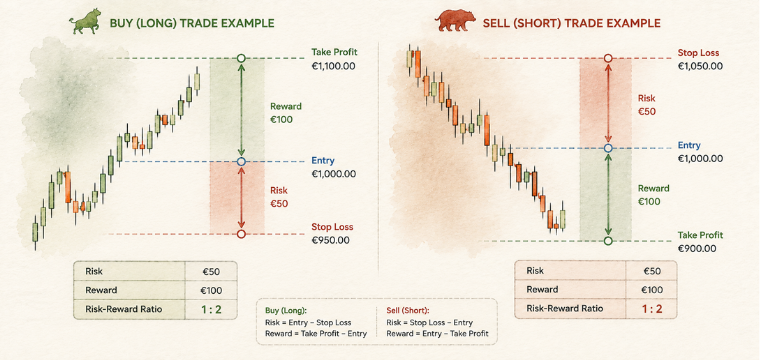
To calculate the risk-reward ratio, you need your entry price, stop-loss price, and take-profit price:
Buy (long) trade example:
For the Sell (short) trade, the formula reverses:
- Risk = Stop Loss − Entry
- Reward = Entry − Take Profit
For a sell at €1,000 with a Stop Loss at €1,050 and Take Profit at €900:
- Risk: €50
- Reward: €100
- Ratio: 1:2
The direction of the trade doesn't change the ratio itself, it only changes which side of the entry the Stop Loss and Take Profit sit on.
How to Set a Risk-Reward Ratio in MT5
Setting a risk-reward ratio in MT5 means placing your Stop Loss and Take Profit at the right distances from your entry price. The platform gives you several ways to do this.
In MetaTrader 5, you can set Stop Loss and Take Profit levels when you place an order or modify them afterward directly from the chart or the position window.
Here is the standard process in MT5 desktop:
- Open the instrument chart and prepare your trade.
- Click New Order (or press F9).
- Enter your Stop Loss price in the order window.
- Enter your Take Profit price in the order window.
- Confirm the order.
- To adjust after entry: right-click the position line on the chart and select Modify or Delete Order.
- Drag the Stop Loss and Take Profit lines directly on the chart to fine-tune the ratio.
MT5 displays your potential profit and loss in real time as you move these levels, so you can confirm the ratio visually before committing.
Practical tip: Calculate your desired SL and TP prices before opening the order window. Entering levels on the fly under time pressure often leads to rounded numbers that don't reflect the intended ratio.
Does MT5 Have a Risk-Reward Calculator?
MT5 does not have a separate risk-reward calculator to use directly on the platform.
By default, standard MT5 does not allow you to lock the Take Profit-to-Stop Loss ratio so that moving one level automatically moves the other, unless you are using a custom Expert Advisor or script. You don't need to do the maths every time a trade needs adjusting. For someone managing trades on a phone, that can save a fair bit of hassle.
If the goal is to work out everything before placing a trade, such as the exact position size, how much money is at risk, or how the risk translates into the account currency, MT5’s built-in features may not be enough. In that case, a separate risk calculator or a broker platform with proper risk management tools is the better option.
Risk Reward Indicator for MT5
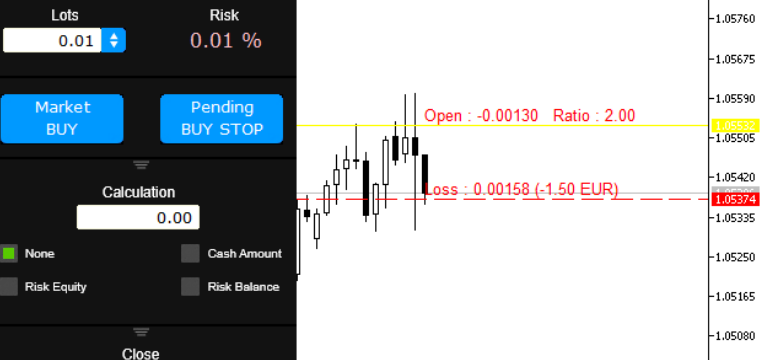
While placing SL and take profit directly shows risk-reward distances on your trades, you can also install custom risk-reward indicator tools in your MT5 setup. Popular options include specialized tools on the MQL5 Market, like the XA Risk Reward Ratio Tool, or free utilities from sites like MT4Gadgets.
Indicator installation steps:
- Download the indicator file from a trusted source.
- Open MT5, go to File, then Open Data Folder.
- Go to MQL5 and then Indicators, and paste your downloaded file there.
- Restart MT5 or right-click the Navigator panel inside MT5 and select Refresh.
- Drag the indicator from the Navigator window straight onto your active price chart.
Key Features of Risk Reward Ratio Indicator MT5
- Risk & Position Sizing Calculation: Automatically calculates lot sizes and risk exposure based on equity, account balance, or a fixed cash amount before opening a trade.
- Interactive Chart Controls: Allows you to adjust Entry Point, Stop Loss (SL), and Take Profit (TP) levels by dragging lines directly on the chart.
- One-Click Execution & Management: Execute market/pending orders, modify rates, cancel positions, or close individual/all active trades with a single click.
- Price Tracking & Level Customization: Features price-following lines and supports adding, removing, or setting constant TP and SL levels.
What Is a Good Risk-Reward Ratio?
While it is straightforward to calculate and set up a risk-reward ratio on MT5, but it is equally important to understand how the system works and what factors affect it. Every trader has a different setup and strategy, and that is why no risk-reward ratio is universally correct. The right ratio for a given trader depends on several interconnected factors:
- Strategy win rate: A higher win rate can support a lower ratio and still produce positive expectancy, while a lower win rate needs a higher risk-reward ratio to produce positive expectancy.
- Asset and market conditions: Volatile instruments may require wider stop-loss levels, which affects the ratio but also means that the profits will be larger.
- Trading strategy: Scalpers, day traders, and swing traders operate on different timeframes and with different average trade structures. For scalpers, 1:2 is generally good, while day traders aim for more than 1:3 and swing and position traders aim for much higher ratios.
- Costs: Spreads and commissions reduce the effective reward on every trade, particularly on short-duration trades.
Traders use 1:2 as a practical baseline because it requires only a 33.3% win rate to break even. But you should test that figure against real historical results, not assume it applies. A ratio that looks strong in theory but doesn't match the strategy's actual win rate will underperform in live trading.
What’s the difference between Risk-Reward Ratio and Win Rate
Risk-reward ratio shows how much you risk versus the potential profit, while win rate shows how often a strategy actually wins.
A good risk-reward ratio looks great on paper, but it means very little if the strategy rarely wins. That is where win rate becomes much more important. It simply tells you how often trades hit Take Profit instead of Stop Loss.
If a trader trades with a 1:3 risk-reward ratio, it might sound impressive. However, if only 15% of trades are winners, the strategy can still lose money. On the other hand, a 1:1 ratio can work perfectly well with a 60% win rate. Neither number tells the whole story on its own, and they are dependent on each other.
Using Pending Orders for Ratio Precision
Pending orders are one of those MT5 features that can make risk-reward management a lot easier. Instead of jumping into a trade at the current price and then scrambling to place the Stop Loss and Take Profit, the whole trade can be planned beforehand.
MT5 offers Buy Limit, Sell Limit, Buy Stop, Sell Stop, Buy Stop Limit, and Sell Stop Limit orders. With each one, the entry price, Stop Loss, and Take Profit can be set before the trade is opened. So when the market finally reaches the entry, the trade already has its risk and target mapped out.
This is especially useful when a trade setup depends on clear technical levels. A trader might want to enter near support, place the Stop Loss below a recent low, and target resistance above. Setting the pending order in advance keeps those levels where they were intended to be, rather than leaving the ratio to be worked out in the heat of the moment.
Common Risk-Reward Mistakes in MT5
Even experienced traders make structural errors when setting risk-reward levels:
- Setting arbitrary Take Profit targets: A TP should have a reason, which should be derived from deep study of the strategy you are trading. If there is no resistance, support, liquidity level, or other clear target there, the market can easily turn before reaching it.
- Trade mismanagement: This is one of the easiest ways to turn a planned trade into a much bigger loss. Moving the SL further away does not improve the setup. It simply means more money is now at risk, usually because the trader does not want to accept that the original idea was wrong.
- Forcing the same ratio on every trade: Markets are dynamic, and forcing a rigid 1:2 or 1:3 target on every setup doesn't work. A wide ratio makes sense for a swing trade with plenty of room to run, but it's often unrealistic for a fast-moving scalp.
- Forgetting about spread and commission: A trade can look profitable before costs and much less attractive after them. This matters even more when the stop-loss is tight. If trading costs eat up a decent chunk of the expected return, the real risk-reward ratio is less attractive than it first appears.
- Treating the ratio like a win probability: A 1:3 risk-reward ratio does not mean the trade has a 1 in 3 chance of winning, or that it is somehow more likely to work. It only tells you how much you could make compared with how much you're risking if the setup plays out.
Final Thought
Understanding the risk-reward ratio and applying it in real time is one of the most crucial aspects of the overall trading process.
Now that you understood everything about the risk-reward ratio, using it in MetaTrader 5 has become much easier with Change. You can apply the concepts in CFD trading across stocks, forex, commodities, crypto and indices, with transparent fees, EU regulation, and a straightforward setup that doesn't require a large initial outlay to get started.
CFDs are complex instruments and come with a high risk of losing money rapidly due to leverage. 56% of retail investor accounts lose money when trading CFDs with this provider. You should consider whether you understand how CFDs work and whether you can afford to take the high risk of losing your money.
FAQs
What is the risk-reward ratio in MT5?
The risk-reward ratio in MT5 compares the potential loss at the stop loss with the potential profit at the take profit.
How do you calculate the risk-reward ratio in MT5?
Dividing the potential loss (Risk) by the potential profit (Reward), or vice versa depending on notation, allows you to determine the risk-reward ratio to calculate the risk-reward ratio for an MT5 trade.
What is a good risk-reward ratio for MT5 trading?
A risk-reward ratio above 1:2 is commonly used, meaning the potential profit is more than twice the amount risked.
How do you set a risk-reward ratio in MT5?
Set the stop loss and take profit levels in MT5 based on the trade’s entry price, risk, and profit target.
Does MT5 calculate risk reward ratio automatically?
MT5 does not natively provide a dedicated risk-to-reward ratio calculator, so traders can calculate it manually or use a risk-to-reward ratio indicator or trade management tool.