Cryptocurrency has reshaped our understanding of money since its adoption has accelerated globally. With digital assets now ranking among the top assets to trade due to high volatility and liquidity, the instruments have also evolved. Crypto CFD trading is one of the most popular ways traders seek to capitalise on cryptocurrency price movements.
Whether you want to profit from rising or falling prices, or simply access crypto markets without managing a wallet, CFDs (Contract for Difference) trading offer a flexible way.
It's important to note that CFDs are complex instruments and carry significant risk, particularly when leverage is involved. They are regulated across the EU by ESMA and national authorities, and are generally better suited to investors with some prior experience.
This guide covers everything from the mechanics of crypto CFD trading, including real trade examples, key comparisons, risk management, and how to get started on a regulated platform.
Key Takeaways
- A crypto CFD (Contract for Difference) lets you speculate on cryptocurrency prices without owning the underlying coin, no wallet or private key required.
- You can trade rising and falling markets, access leverage, and switch between assets like Bitcoin, Ethereum, Solana, and XRP from one account.
What Is Crypto CFD Trading?
Crypto CFD is a financial instrument that allows traders to speculate on cryptocurrency price movements without owning the underlying asset. A CFD (Contract for Difference) is a financial agreement between a trader and a broker to exchange the difference in an asset's price from when the trade opens to when it closes.
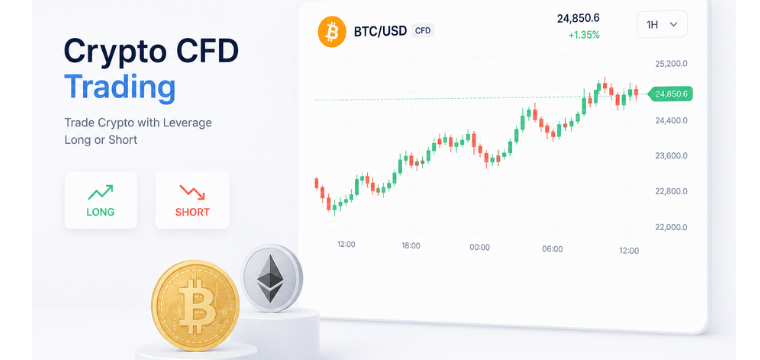
In simple terms, while buying a CFD, you choose a cryptocurrency, decide whether the price will rise or fall, and open a position. If you're right, you profit; if you're wrong, you lose. At no point do you hold the actual coin.
Buying Bitcoin directly means owning an asset you can store, transfer, and stake. Trading a Bitcoin CFD means participating in its price action, without wallets, private keys, or blockchain transactions. For traders focused on short- to medium-term price opportunities, CFDs offer a cleaner, faster, and more strategically flexible entry into crypto markets.
CFDs originated in equity markets and became widely used in forex and commodity CFD trading before expanding into crypto. Today, EU-regulated platforms like Change offer crypto CFDs alongside stock, commodity, and forex CFDs, all within a single retail investor account and interface.
How Does Crypto CFD Trading Work?
Crypto CFD trading is built on the simple practice of speculating on price direction. The trader collects the difference if you're correct and absorbs it if you're not. However, what makes CFDs especially interesting is their leverage. The mechanics of leverage and margin make it important to understand the product in detail before you trade.
When you open a CFD position, you deposit a fraction of the full trade value, known as margin. The broker provides the remaining exposure. This is leverage, and it changes how both gains and losses behave.
Understanding Leverage in Crypto CFDs
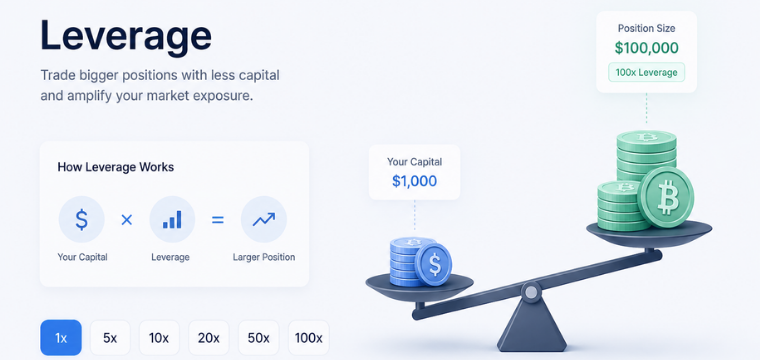
Leverage is expressed as a ratio in the financial markets. With 5x leverage, a €200 deposit gives you exposure to a €1,000 position. In this leveraged position, both your profits and losses will be multiplied according to the leverage. For example, a 5% move in the market will produce a 25% gain or loss on deposited capital.
However, it is important to understand that leverage is a double-edged sword; while the larger position can increase your profit potential, it can also increase the size of losses.
Crypto assets can swing 10–20% in a single trading session, which is why leverage demands careful, deliberate use. Knowing your maximum loss before you open a trade, not after, is the discipline that separates sustainable trading from gambling.
CFDs are complex instruments and carry a high risk of rapid loss of capital due to leverage.
Going Long vs. Going Short
One of the defining advantages of crypto CFD trading is the ability to profit in both rising and falling markets. A trader can bet on both an increase and a decrease in price.
Example 1: Going Long on Bitcoin
Bitcoin is priced at €65,000. You open a long CFD position with a €400 margin at 10x leverage, giving you €4,000 market exposure.
- BTC rises 5% to €68,250 - Gain €200 (50% return on margin)
- BTC falls 5% to €61,750 - Lose €200 (50% loss on margin)
Example 2: Going Short on Ethereum
Ethereum is priced at €2,000. You open a short CFD position with a €200 margin at 5x leverage, giving you €1,000 market exposure.
- ETH falls 8% to €1,840 - Gain €80 (40% return on margin)
- ETH rises 8% to €2,160 - Lose €80(40% loss on margin)
These examples show precisely how leverage accelerates both outcomes. The same mechanism that magnifies gains also magnifies losses at the same rate, which makes stop-loss placement and position sizing essential, not optional.
CFDs are complex instruments and come with a high risk of losing money rapidly due to leverage. 60% of retail investor accounts lose money when trading CFDs. You should consider whether you understand how CFDs work and whether you can afford to take the high risk of losing your money.
Crypto CFD Trading vs. Spot Trading
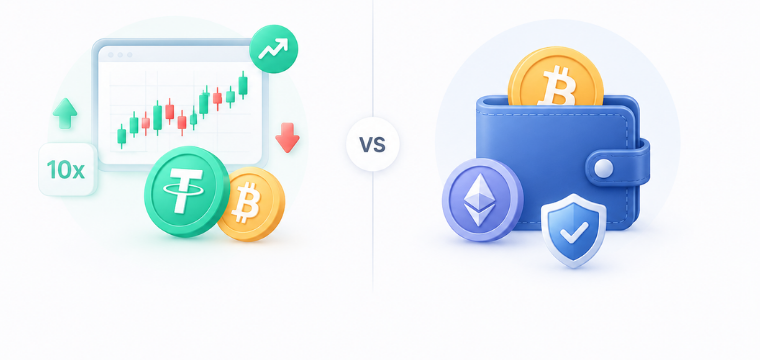
Crypto CFD trading and spot trading are fundamentally different approaches to the same market. While spot trading gives you ownership of the asset, CFDs are instruments, like futures and options, that only provide the right to speculate on the asset. For a trader choosing between spot and crypto CFDs, the choice depends on trading goals, position sizing, risk appetite, and timeframe.
In spot trading, you own Bitcoin, Ethereum, or whichever coin you purchase, and you benefit from long-term appreciation, can hold across wallets, and may earn staking rewards.
With crypto CFD trading, you never hold the underlying coin; rather, you speculate purely on price. In exchange for that, you gain the ability to go long or short, access leverage, and trade across multiple assets.
Beginner investors might get confused about which approach to choose, but neither is superior; the right choice depends entirely on your trading goals. Spot buying is best suited for long-term investors accumulating Bitcoin or Ethereum. For active traders seeking to profit from price movements in both directions, CFDs are the preferred instruments.
On modern platforms like Change, both types of instruments are available under a single umbrella. You can invest in real crypto for the long term and trade CFDs for shorter-term strategies, from the same app, without switching platforms.
Crypto CFDs vs. Futures
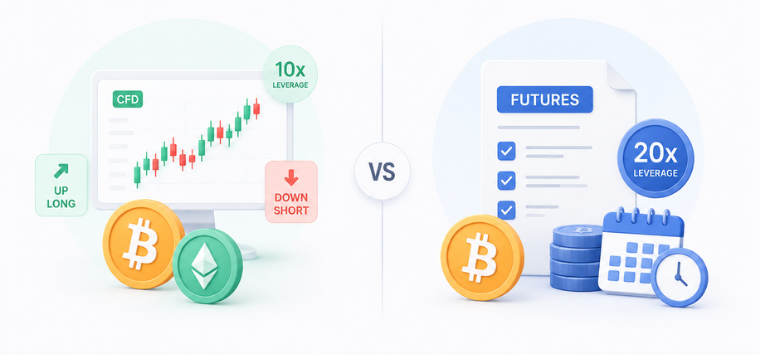
Crypto CFDs and futures contracts are both derivatives that require margin and derive their value from an underlying asset, but they're designed for different traders and operate under very different conditions.
A futures contract is a standardised agreement to buy or sell an asset at a set price on a specific future date. Futures are exchange-traded, often carry higher minimum capital requirements, and are commonly used by institutional or professional traders. The fixed expiry date introduces complexity: traders must roll positions if they want to maintain exposure beyond the contract date.
Unlike futures, crypto CFDs have no expiry date. You open and close the position on your own timeline, subject only to overnight funding charges. Investors should therefore include these funding charges when considering the trading cost of holding positions for extended periods.
For most retail investors who are new to derivatives, crypto CFDs are the more accessible starting point. The absence of expiry dates, lower minimums, and simpler mechanics gives traders more room to learn while keeping complexity manageable.
Which Cryptocurrencies Can You Trade as CFDs?
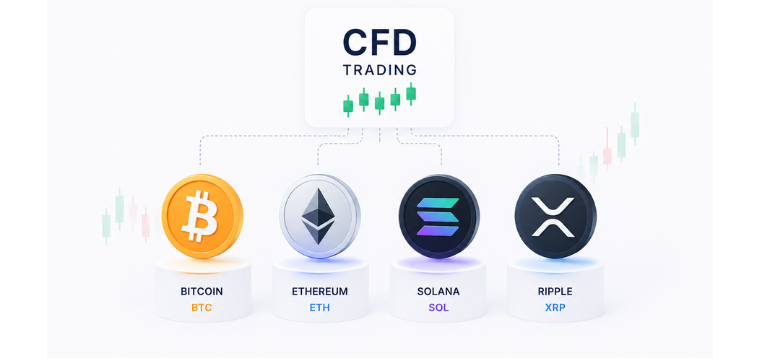
Most regulated crypto CFD platforms offer a broad selection of assets, from high-liquidity majors to more volatile altcoins:
Bitcoin (BTC): BTC is the most-traded crypto CFD globally. It offers high liquidity, relatively tighter spreads compared to altcoins, and a price history that has established recognisable patterns for technical traders. Bitcoin CFDs are typically the entry point for traders new to crypto derivatives.
Ethereum (ETH): ETH is the second-most actively traded crypto CFD. Ethereum's price responds to a distinct mix of forces, including broader market sentiment, DeFi ecosystem activity, and network-specific developments, giving traders a different dynamic to work with compared to Bitcoin.
Solana (SOL): SOL is known for its volatility relative to the larger-cap coins. SOL has experienced dramatic rallies and sharp corrections, creating strong opportunities for traders who understand how to manage that high-risk profile.
Ripple (XRP): XRP remains one of the most traded altcoins by volume. Its price is especially sensitive to regulatory news and ecosystem announcements, so active traders often monitor a different set of catalysts than those for BTC or ETH.
On Change, you can trade nearly hundred cryptocurrencies as spot or CFDs, including all four of the above, alongside stock CFDs, commodity CFDs, and forex pairs, from one mobile-first platform.
Crypto CFD Trading Strategies
There is no single correct approach to trading crypto CFDs; it all depends on your trading goals and risk appetite. However, several well-established strategies suit different timeframes, risk tolerances, and levels of available time.
The most important step before applying any strategy is understanding your risk parameters: what you're willing to lose on a single trade, your profit target, and how you'll respond if the market moves against you. Strategy without risk management is just speculation with extra steps.
1. Day Trading Crypto CFDs
Day trading involves opening and closing positions within the same session, targeting intraday price movements that crypto markets frequently deliver. Because crypto runs 24/7, "intraday" is flexible, but most day traders focus on periods of peak volume.
Day traders typically rely on technical indicators such as support and resistance levels, volume profiles, and moving averages to time entries and exits. The risk is acute: leverage in short-term moves can increase the risk of losing money rapidly if trades aren't managed with strict stop-loss orders. Low leverage and tight risk parameters are especially critical for anyone trading at this frequency.
2. Swing Trading Crypto CFDs
Swing trading means holding a position for several days to a few weeks, targeting broader price swings rather than intraday noise. This approach is better suited to traders who can't monitor screens continuously and prefer to make fewer, more deliberate decisions.
Swing traders typically combine technical analysis with a view on overall global market direction, whether the trend is broadly bullish or bearish. CFDs suit swing trading well because there are no expiry dates, and positions can remain open as long as the overnight funding cost is factored into the risk/reward calculation.
How to Start Trading Crypto CFDs
Here is the step-by-step process for getting started with cryptocurrency CFD trading:
- Choose a regulated platform: Always trade with a broker licensed and regulated in your jurisdiction. Regulated platforms give traders a meaningful layer of legal protection.
- Open and verify your account: Standard KYC (Know Your Customer) identity verification is a legal requirement for all regulated brokers. Expect to provide ID and proof of address.
- Deposit funds: You can start with as little as €10. Card deposits are available from most brokers, with zero deposit fees and instant funding. Choose which cryptocurrency you want to trade as a CFD: Bitcoin, Ethereum, Solana, XRP, or any available asset.
- Define your trade parameters: Set your position size and choose your leverage level. Crucially, set your stop-loss before the position opens, not after.
- Open your position: Go long if you expect the price to rise; go short if you expect it to fall. Adjust your stop-loss as the trade progresses if conditions improve. Never move it in the wrong direction to delay an inevitable exit.
- Close and settle: When your target is reached or conditions change, close the position. Profit or loss settles in your account immediately.
Bottom Line
Crypto CFD trading gives you a flexible, accessible way to engage with cryptocurrency markets, without wallets, without owning the underlying asset, and without being locked into rising prices only. The ability to go long or short and trade major coins like Bitcoin, Ethereum, Solana, and XRP on a single regulated platform makes it a practical option for active traders.
That flexibility comes with real risk, particularly when leverage is involved. Approach it with a clear strategy, strict stop-losses, and position sizes you can afford to lose, and CFDs become a powerful addition to your broader investment toolkit.
Frequently Asked Questions (FAQs)
What is crypto CFD trading?
Crypto CFD trading allows traders to speculate on cryptocurrency price movements without owning the underlying digital assets.
How do crypto CFDs differ from buying cryptocurrency?
Crypto CFDs provide exposure to price changes, while buying cryptocurrency gives direct ownership of the asset.
Can you short-sell cryptocurrencies with CFDs?
Yes, cryptocurrency CFDs allow traders to profit from both rising and falling cryptocurrency markets through long and short positions.
What are the main risks of crypto CFD trading?
The main risks include market volatility, leverage-related losses, and rapid price movements in cryptocurrency markets.
CFDs are complex instruments and come with a high risk of losing money rapidly due to leverage. 60% of retail investor accounts lose money when trading CFDs with this provider. You should consider whether you understand how CFDs work and whether you can afford to take the high risk of losing your money.
Which cryptocurrencies can be traded as CFDs?
Most CFD brokers offer popular cryptocurrencies such as Bitcoin, Ethereum, Solana, and XRP as CFD trading instruments.