MetaTrader 4 (MT4) was launched in 2005 and has become one of the most popular trading platforms. MetaTrader 5 (MT5) came out in 2010 and has since overtaken it as the platform most new traders choose.
Choosing between MT4 and MT5 depends on your trading needs, as both platforms have their own strengths and characteristics. The main difference between the platforms is that MT4 was primarily designed for forex traders, while MT5 goes much further, supporting multi-asset trading and offering advanced charting, 80+ indicators, a wide range of markets (depending on the broker), and powerful algorithmic trading tools, including Expert Advisors.
MetaTrader platforms do not hold funds; trades are executed through your broker or independently. They act as the interface between you and your broker's liquidity.
This article explains the key differences and helps you decide which platform suits your trading objectives.
Key Takeaways
- MT4 is a forex trading-centric platform with a large library of legacy tools, while MT5 is a multi-asset platform with more markets, more indicators, and significantly stronger algorithmic trading capabilities.
- For most traders starting out in 2026, MT5 is the more capable, future-ready platform.
MT4 vs MT5: Key Differences at a Glance
What Is MetaTrader 4?
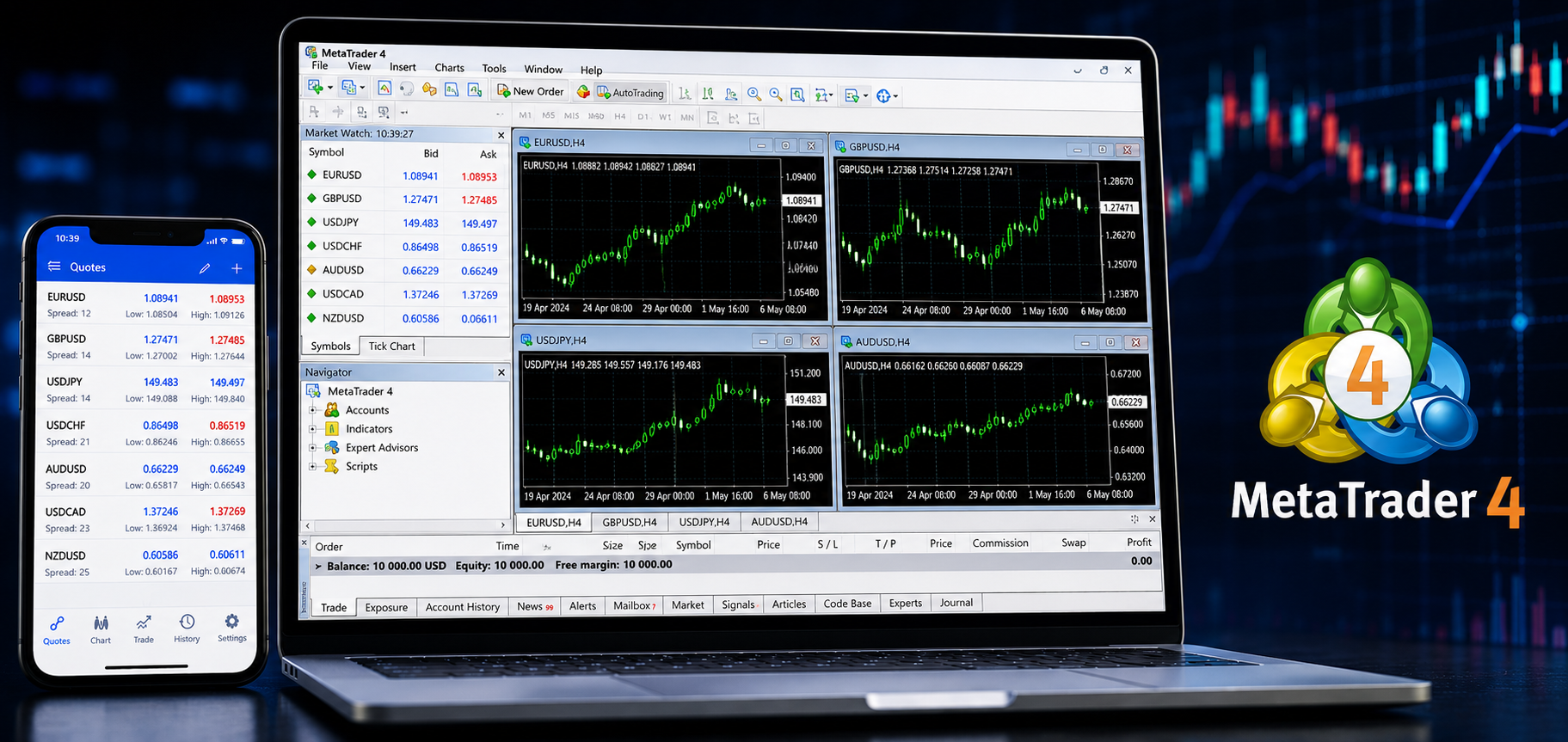
MetaTrader 4, launched by MetaQuotes in 2005, became the global standard for retail forex traders worldwide. For nearly two decades, it has powered millions of forex traders' accounts across brokers worldwide.
MT4 is built around simplicity and familiarity. You need to connect the trading platform to your forex brokers to start trading. It offers 9 timeframes, 23 analytical objects, 30 built-in technical indicators, and 4 pending order types- a straight and simple package that suits forex market trading strategies.
Its biggest strength today is its legacy ecosystem, which includes a vast library of community-built Expert Advisors, indicators, and scripts that traders have relied on for years. However, MetaQuotes officially ended new development on MT4 in 2022, and it no longer receives updates or new features.
MT4 features
- Market focus: MT4 is built for forex and CFD trading. MT5 supports a broader, multi-asset range.
- Analysis Tools: MT4 gives traders access to real-time price charts, 23 analytical objects, 30 built-in technical indicators, and 9 timeframes to analyse forex markets and identify trading opportunities.
- Trading Execution: The platform supports market, pending, and stop orders, with fast execution directly from the chart or the order panel.
- Automated Trading: MT4 supports Expert Advisors (EAs), automated programs that execute trades based on predefined rules, allowing traders to run strategies without manual intervention.
- Mobile Trading: MT4 is available as a mobile app for iOS and Android, allowing traders to monitor positions, place orders, and manage accounts from anywhere.
What Is MetaTrader 5?

MetaTrader 5 is MetaQuotes' next-generation platform, released in 2010 and built from the ground up to handle far more than forex. It supports CFDs on stocks, ETFs, indices, commodities, futures, and crypto CFDs, all within a single, unified interface.
MT5 runs on a 64-bit architecture, which means faster execution, better memory handling, and more efficient processing of complex data, a meaningful upgrade over MT4's 32-bit foundation.
While MT4 is a specialist forex tool, MT5 is a true multi-asset trading environment. It delivers deeper market analysis, a broader range of instruments, and significantly more advanced tools for traders who want to automate or scale their strategies.
Change has integrated MetaTrader 5 to give traders multi-asset access from one place. When you trade through Change, you use the same margin account you already have. There’s no need to open another account, add funds separately, or transfer money between platforms. Your account balance, available margin, and trading funds stay connected in one place, making it easier to manage your trades.
CFDs are complex instruments and come with a high risk of losing money rapidly due to leverage. 60% of retail investor accounts lose money when trading CFDs with this provider. You should consider whether you understand how CFDs work and whether you can afford to take the high risk of losing your money.
MT5 Features
- Market focus: Unlike MT4, MT5 allows trading in all major assets, including CFDs on Forex, stocks, indices, commodities, and cryptocurrencies.
- Advanced Charts and 21 Timeframes: MT5 offers 21 chart timeframes, from 1-minute to monthly, along with additional chart types and an expanded suite of drawing tools for in-depth technical analysis.
- 80+ Built-In Technical Indicators: The platform includes over 80 native indicators covering trend analysis, oscillators, volume, and volatility, more than double what MT4 provides out of the box.
- Algorithmic Trading and Expert Advisors: MT5 offers advanced EA support powered by MQL5, a more advanced programming language, along with a multi-threaded Strategy Tester for faster, more accurate backtesting and optimisation.
- Built-In Economic Calendar: MT5 includes a live economic calendar directly inside the platform, displaying key market events such as interest rate decisions, inflation data, and employment figures.
- Depth of Market (DOM): Traders can view the real-time order book at each price level, gaining insight into where significant buy and sell orders are positioned.
- Mobile Trading: MT5 is available on iOS and Android with full functionality, including chart analysis, order placement, EA monitoring, and account management on the go.
- MQL5 Marketplace: Traders can browse and install thousands of pre-built Expert Advisors, indicators, and scripts directly within the platform, no coding experience required.
MT4 vs MT5: Which is Better?

The trading landscape has shifted significantly over the last decade. Traders increasingly want access to multiple asset classes from a single platform, without juggling accounts or applications.
While the right platform for you depends entirely on your trading process and goals, MT5 has edged over MT4 as it meets the new-age trader’s demand. Beyond broader access to financial markets, it includes analytical tools that give traders a genuine advantage.
Advanced Charts and 21 Timeframes
MT5 offers 21 chart timeframes, more than double MT4's nine, spanning everything from 1-minute intraday views to monthly long-term charts. It also includes additional chart types and a wider selection of drawing tools.
This level of granularity matters for traders who need to analyse price structure across multiple timeframes at once. Whether you are scalping short-term moves or tracking a longer swing position, MT5's charting tool suite handles it without switching screens.
80+ Built-In Technical Indicators
MT4's 30 built-in indicators cover the basics, but MT5's library of 80+ native indicators represents a substantial leap. It includes trend-following tools, oscillators, volume analysis indicators, and volatility measures, all built in and ready to use without installation.
Traders can also load custom indicators on top of this built-in library, layering signal strategies that would be difficult or impossible to replicate on MT4 without third-party workarounds.
Access to Multiple Markets
One of MT5's defining advantages is the breadth of instruments available from a single login. Traders can access:
- Forex: major, minor, and exotic currency pairs
- Stock CFDs: exposure to global equities without direct ownership
- Index CFDs: trade the S&P 500, DAX, Nasdaq, FTSE 100, and more
- Commodities: gold, silver, oil, natural gas, and agricultural markets
- Crypto CFDs: BTC, ETH, and a wide range of digital assets
This matters because CFD trading and crypto exposure are increasingly central to how self-directed investors build diversified portfolios. MT5 removes the need for a separate platform for each asset class.
Algorithmic Trading and Expert Advisors on MT5
This is where MT5 genuinely separates itself, and where serious traders find their most significant edge.
Expert Advisors (EAs) are automated trading programs that run inside the MetaTrader platform and execute trades based on a pre-defined rule set. They operate 24/7, meaning your strategy continues running even when you are not watching the screen.
What Expert Advisors can do:
- Enter and exit trades automatically based on technical signals
- Apply consistent risk management on every position
- Trade across multiple instruments simultaneously
- Run on a Virtual Private Server (VPS) for uninterrupted uptime
MT5 improves substantially on MT4's EA environment in two key ways. First, the multi-threaded Strategy Tester allows traders to backtest and optimise EAs across multiple parameter sets simultaneously, a process that is far faster and more accurate than MT4's single-threaded equivalent. This means you can test how a strategy would have performed across years of historical data in a fraction of the time.
Second, MT5 uses MQL5, a more advanced programming language that is more closely related to C++ in structure. MQL5 supports more complex logic, cleaner code, and far better performance than MQL4. It also connects directly to the MQL5 Marketplace, an in-platform store with thousands of pre-built Expert Advisors, indicators, and scripts available to download, free or paid.
For traders exploring algorithmic trading strategies, MT5 is the clear platform of choice in 2026. The combination of a stronger backtester, a more capable language, and an active developer community makes it a genuinely professional-grade environment.
MT4 vs MT5 for Different Trading Styles
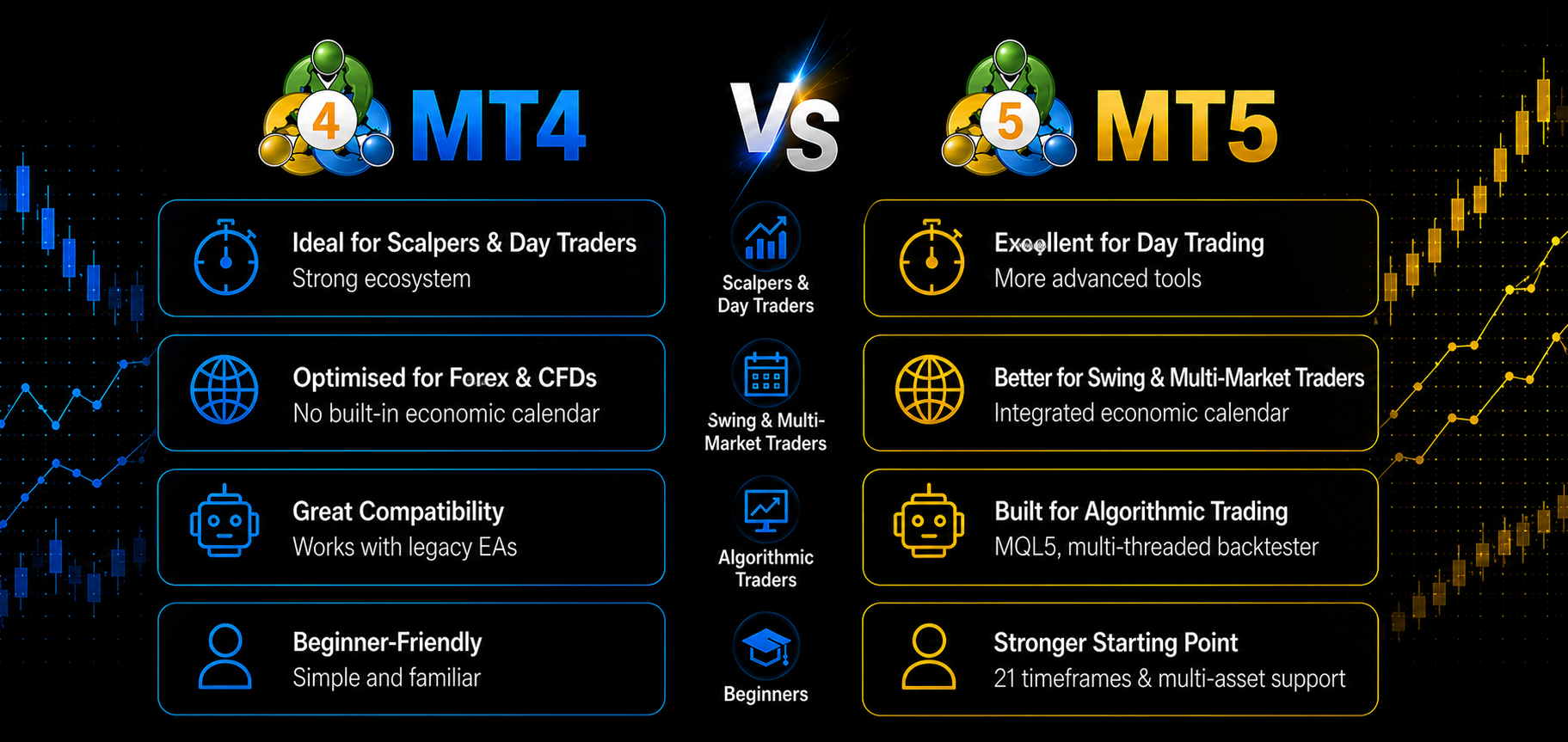
The better platform often comes down to how you trade, not just what you trade.
Forex scalpers and day traders who have built their entire strategies around MT4-specific indicators or legacy EAs may have little reason to switch, particularly if those tools cannot be easily converted to MQL5. MT4's established ecosystem remains a strength for this group.
Swing traders and multi-market traders who want to combine technical analysis with the economic calendar, or move between forex and indices within the same session, will find MT5 significantly better suited to that workflow.
Algorithmic traders benefit most from MT5. The multi-threaded backtester, MQL5 language, and MQL5 Marketplace make it a more powerful environment for developing, testing, and running automated strategies at scale. Industry reports suggest MT5 has been gaining ground among new brokers and traders in recent years as multi-asset trading has grown, though many established forex traders continue to use MT4.
Beginners entering trading for the first time will generally find MT5 the stronger starting point. Its 21 timeframes, broader market access, and modern infrastructure mean you are unlikely to outgrow it.
Bottom Line
Both MT4 and MT5 are powerful platforms built by MetaQuotes, but the direction of travel is clear. MT5 offers more markets, more indicators, advanced charting, and superior algorithmic trading tools, making it the stronger choice for traders looking to expand beyond forex. If you are starting out or looking to expand, MT5 is the platform built for the markets of the future.
The good news is you do not have to look far to get started. A reliable cfd trading platform helps you make the most of MT5's advanced features. Change integrates directly with MetaTrader 5, giving you access to crypto, CFDs, forex, indices, and commodities, all through one EU-regulated platform. Start with a minimum deposit and experience MT5's full power through Change's clean, mobile-first interface.
FAQs
Is MetaTrader 5 better than MetaTrader 4?
MetaTrader 5 is better for most traders because it offers more indicators, faster execution, additional order types, and supports more asset classes.
Can I use my MT4 account on MT5?
No, MT4 and MT5 use different server infrastructure, so accounts cannot be used interchangeably.
How to trade on MetaTrader 5?
Create your account on Change, verify your account, open a margin account, Head to Settings in the app, tap MT5 Password Reset, get your credentials, log in to MT5, choose a market, analyze the chart, place an order, and monitor the trade.
Why are brokers switching from MT4 to MT5?
Many brokers prefer MT5 because it receives ongoing updates, offers better performance, and supports a wider range of markets.
Which is better for beginners, MT4 or MT5?
MT5 is generally the better choice for beginners due to its modern interface, built-in tools, and long-term platform support.
CFDs are complex instruments and come with a high risk of losing money rapidly due to leverage. 60% of retail investor accounts lose money when trading CFDs with this provider. You should consider whether you understand how CFDs work and whether you can afford to take the high risk of losing your money.