CFD Trading risk management is a crucial pillar of a successful trading system. It's a top priority for successful traders, and effective risk management separates those who make consistent profits from those who consistently blow up accounts.
A robust risk management framework includes key risk management tools and core strategies that help traders avoid the risk of ruin. This guide will walk you through the complete process, including calculating position size, placing stop-losses, managing leverage, margin, and correlated positions so you can build your own CFD risk management framework.
CFDs are complex instruments and come with a high risk of losing money rapidly due to leverage. 56% of retail investor accounts lose money when trading CFDs with this provider. You should consider whether you understand how CFDs work and whether you can afford to take the high risk of losing your money.
Key Takeaways
- Risk management in CFD trading controls how much capital is exposed to loss per trade and across an entire portfolio, using position sizing, stop-losses, leverage limits and margin monitoring.
- The core process is set: a maximum risk per trade → determine stop-loss level → calculate position size → check leverage and margin → review total portfolio exposure.
What is CFD trading risk management?
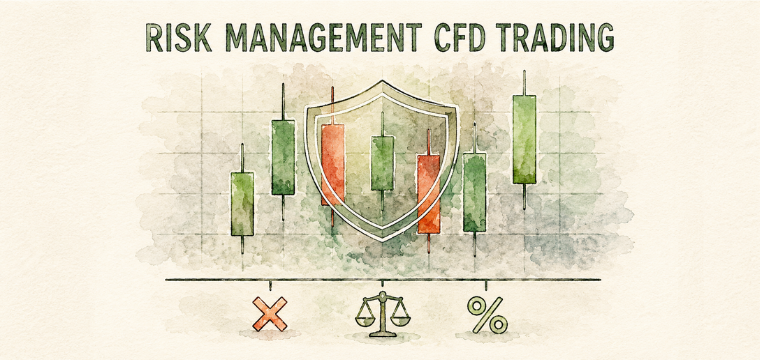
Risk management in Contract for Difference CFDs trading is the process of defining and limiting financial exposure on leveraged positions, at both the individual trade level and across a full portfolio.
The framework is not defined by a single setting or tool. It is a well-structured, repeatable approach that determines how much capital is at risk, under what conditions, and how that risk is controlled throughout the life of a trade.
Understanding how these elements interact is what separates structured trading from guesswork.
The key components of a CFD risk management framework include:
- Risk per trade: This is the maximum amount a trader is willing to lose on a single position. This is calculated both per trade and at the portfolio level. A lot of traders generally have a risk of 1-5% per trade at the portfolio level.
- Position sizing: Position size is not calculated randomly; it is calculated based on the trade's stop-loss.
- Stop-loss orders: It is a pre-decided and set instruction to close a position when the price reaches a defined level.
- Leverage control: Managing total exposure relative to available margin.
- Risk-reward ratio: A positive expectancy system has a good risk-to-reward ratio. Include a proper backtest comparing potential loss to potential gain before entering a trade.
- Portfolio exposure: A single trade risk is not enough; you must manage combined risk across all open positions, including correlated trades.
- Trading costs: Spreads, overnight financing charges, and other costs that affect net trade outcomes
- Slippage and gap risk: The possibility of execution at a worse market price than the stop-loss level.
How do you manage risk when trading CFDs?
Managing risk in CFD trading is about having a process and sticking to it. Going through the same checks before every trade leaves less room for rushed decisions, especially when the financial market moves fast and emotions take over.
Here is a step-by-step risk management process for CFD trades.
1. Set a maximum risk per trade
Before placing a trade, know exactly how much you are willing to lose if it goes wrong. Many traders use a fixed percentage of their account (commonly 1–2% per trade, up to 5% total portfolio risk), but there is no magic number that works for everyone. Traders commonly cap risk per trade as a small percentage of total account value, though the right number depends on individual circumstances and risk tolerance.
Account size, trading strategies, frequency, and how much drawdown you can handle will all affect the risk per trade.
2. Decide where the stop-loss goes
Do not pick a stop-loss just because it is 1% or 2% away from your entry. It could be below the support, above resistance, outside a demand or supply zone, or at a level based on volatility. Your method should be like where should my trade be going invalid, and that is where the stop-loss should be placed.
3. Work out your position size
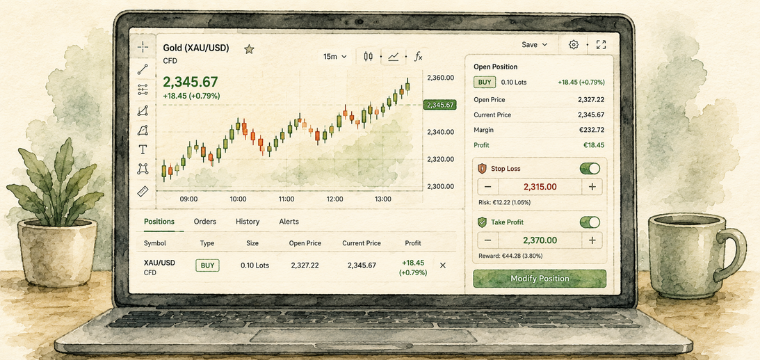
After you have calculated your maximum dollar risk, divide it by your stop-loss distance to get the right position size.
For example, let's say you have a $10,000 account and follow a 1% risk rule, your maximum loss is capped at $100. If you open a CFD position at €150 and set a stop-loss at €145, you are risking €5 per unit; dividing your €100 total risk by that €5 risk per unit means your correct position size is exactly 20 units.
A common mistake is choosing a position size first and then trying to squeeze a stop-loss around it. However, you have to decide the risk first, then calculate the position size that fits within your limit.
4. Check leverage and margin
Leverage can make a small account look capable of taking a much bigger position, but it also increases risk. So, calculate risk based on full trade margin, not just the money you are putting in.
Additionally, before entering, check how much margin the trade will use and how much free margin will be left afterward. The position should have enough room to handle normal market price swings without putting the account at risk of a margin call. To understand margin and real-time trading experience, you can also use a free demo trading account from brokers.
5. Check the risk-reward ratio
Before clicking buy or sell, know whether the trade fits your system’s risk-reward rules. If your system has less than a 30% win rate, you should strictly avoid trades with a risk-reward ratio below 1:2.5 or 1:3 to remain profitable. Traders often check that a trade's potential reward justifies its risk before entering, for example, comparing a system's historical win rate against its typical risk-reward ratio.
A good risk-reward ratio cannot turn a bad trade into a good one, but it can help filter out poor setups.
6. Look at your total exposure
Risk is managed first on your portfolio level rather than on specific trades. So, before opening any new trades, check what is already open in the account. Taking long positions in several assets that tend to move together can leave you carrying far more risk than it appears on the surface.
7. Place the trade with your risk orders
Once everything checks out, enter the trade with the stop-loss already set. If a take-profit level makes sense for the strategy, set that too. Do not leave the stop for later because it is easy to get distracted, second-guess the trade, or simply forget.
8. Keep an eye on the position
After entering, there is no need to stare at the chart every second. Keep track of the things that actually matter, such as margin usage, overnight financing and upcoming economic events that could move the market. If something genuinely changes the trade setup, reassess the position. Do not keep moving the stop or changing the plan just because the price happens to move against you for a few minutes.
How do you calculate CFD position size?
Position sizing is simply about figuring out how much to put in a trade while keeping your risk under control. Once you know how much you are willing to lose and where your stop-loss is, you can work out the right position size without putting more money at risk than planned.
The formula:
Position size = Maximum acceptable loss ÷ Stop-loss distance per unit
Worked example:
What to factor in beyond the formula
The formula gives you a good starting point, but there are a few other things to check before deciding on the final position size:
- Some CFD contracts are traded in lots, while others use contracts or points, so keep in mind whether the lots meet your risk criteria.
- Check for forex conversion if the CFD is priced in a different currency from your trading account.
- If you plan to keep the trade open beyond the trading session, keep overnight financing in mind.
The basic approach is the same whether you are trading crypto, stocks, commodities or indices through CFDs. The numbers change, but the calculation does not.
How do you use stop-losses in CFD trading?
A stop-loss is an order that closes a CFD position once the price reaches a level set by the trader, helping limit how much can be lost if the trade moves in the wrong direction. It is one of the simplest risk management tools, and for a lot of traders, it is part of the trade plan before the position is opened rather than something decided later.
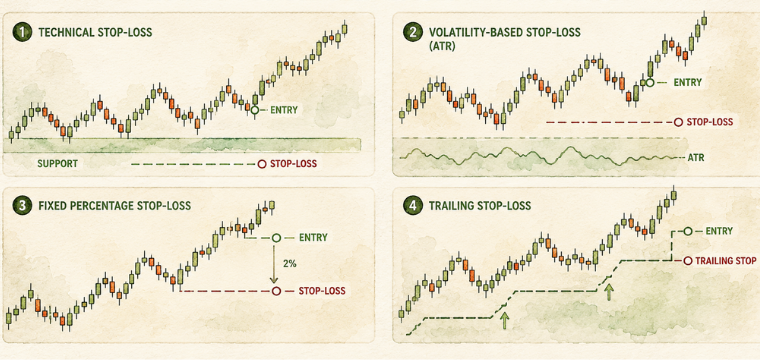
There are several ways to set a stop-loss, and the best choice usually depends on the strategy and the market.
- A technical stop-loss can sit below support on a long trade or above resistance on a short trade, using a level that makes sense on the chart.
- A volatility-based stop looks at how much the instrument normally moves, often using the Average True Range (ATR), so the stop is not sitting so close that normal price movements knock the trade out.
- A fixed percentage stop keeps things simple by placing the stop a set percentage away from the entry price.
- Trailing stop moves with the market when the trade moves into potential profit, giving the position room to keep running while gradually protecting gains.
Some brokers also offer guaranteed stop-losses, which can close the position at the exact price chosen by the trader, although this normally comes with an extra charge.
However, it is crucial to keep in mind that a normal stop-loss does not guarantee the position will close at the exact price set. If the market volatility suddenly moves through the stop, or opens at a very different price after an overnight or weekend gap, the order may be filled at a worse level. This difference is known as slippage or a price gap, and it can make the actual loss larger than expected.
What is CFD margin and margin call risk?
Margin is the money a trader needs to have in the account to open and keep a leveraged CFD position running. It is not a trading fee or a charge taken by the broker. Instead, it is money set aside as security against potential losses, and once the position is closed, that margin becomes available again.
- Initial margin is the amount needed to open a position, while maintenance margin is the minimum equity that must remain available for the position to stay open.
- Free margin is the money left in the account that is not currently being used as margin for open trades.
A margin call happens when the account falls below the required level, meaning the trader may need to add money or close some positions to bring the risk back down. If the account falls even further, a stop-out or automatic liquidation can occur, where the broker automatically liquidates positions to prevent negative balances, regardless of whether a manual stop-loss was hit.
EU financial authorities have also warned that CFD traders may have to respond quickly to margin calls when markets become particularly volatile. If the required funds are not added in time, the broker may close positions at an unfavorable price, leaving the trader with a larger loss than expected.
Free margin is therefore worth monitoring while trades are open, rather than only checking the account balance.
Risk management checklist for CFD Trading
For beginners, a risk management strategies checklist is a must; writing it down and checking it before and after trades builds discipline over time.
- Maximum risk per trade defined in monetary terms at the portfolio and specific trade level.
- Stop-loss level selected based on technical or volatility analysis
- No random position sizing; calculated from the stop-loss distance and maximum risk
- Leverage and margin requirement confirmed
- Free margin verified as sufficient
- Stop-loss order placed at the time of entry
- Potential monetary loss calculated and confirmed within limits
- Potential reward calculated and risk-reward ratio reviewed
- Correlated positions checked, combined risk exposure within portfolio limits
- Spread and overnight financing costs factored into the trade plan
- Overnight or event risk evaluated
- Trade recorded with entry price, stop, target, size, and rationale
Bottom Line
CFD risk management is not something to set up once and forget about. It has to be part of every trade, whether the last one was a winner or a loser. Know the most you are willing to lose before entering, work out the position size from your stop-loss, and keep an eye on how much risk is sitting across the whole account. These basics go a long way towards keeping losses under control.
For traders who want to put these ideas into practice, the Change CFD trading platform provides access to indices, commodities, crypto, forex and equity CFDs with transparent fees and no hidden costs. This also makes it easier to factor the actual trading costs into the risk calculations before placing a position
FAQs
What is the best way to manage risk when trading CFDs?
Use appropriate position sizes, set stop-losses, limit leverage, and control your overall market exposure.
How much should I risk per CFD trade?
Many traders limit risk to a small percentage of their trading capital, often around 1% to 2% per trade.
How can I reduce high risk when trading CFDs?
Use appropriate position sizes, set stop-losses, limit leverage, diversify exposure, and follow a clear trading plan.
Why is position sizing important in CFD trading?
Position sizing helps ensure that one losing trade does not cause a disproportionately large loss to the trading account.
Can risk management eliminate losses in CFD trading?
No, risk management cannot eliminate losses, but it can help limit their size and protect trading capital.