CFDs and options are two of the most popular leveraged trading instruments traders use to speculate on price, but they differ significantly in how they work.
Both instruments give you leveraged access to financial markets without owning the underlying asset, but they work in completely different ways, carry different cost structures and suit very different types of traders.
Before trading these instruments, it's crucial to understand their advantages and disadvantages, as they can have a huge impact on your trading.
Key Takeaways
- CFDs track an asset's price directly, have no fixed expiry date and are simpler to use for short-term speculation.
- Options give traders the right, not the obligation, to buy or sell an asset at a set price before a specific expiry date.
What is the difference between CFDs and options?
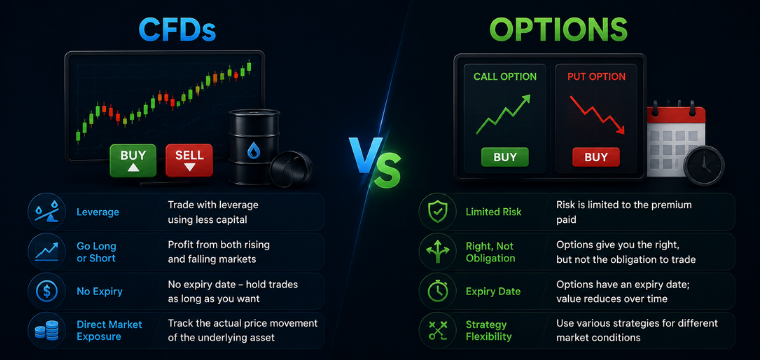
The difference between CFDs and options lies in how they operate, even though both are leveraged instruments and don’t provide ownership to the underlying asset. A CFD tracks the asset’s price movement like a futures trade contract but without any expiration date. Meanwhile, options are financial instruments that grant the right, not the obligation, to buy or sell an underlying asset at a specific price before expiry. It is like paying a reservation fee to secure the right to trade.
With both instruments, traders can go long or short selected markets without taking ownership of the underlying asset, but the way they move and how time affects them are very different.
CFD trading is in general simpler and better suited to traders who don’t want the complexity of options strategies, while options offer more strategic flexibility for hedging and defined‑risk positions.
CFD vs Options at a Glance
Here is the table comparing CFD vs options on various factors:
CFD Trading Basics
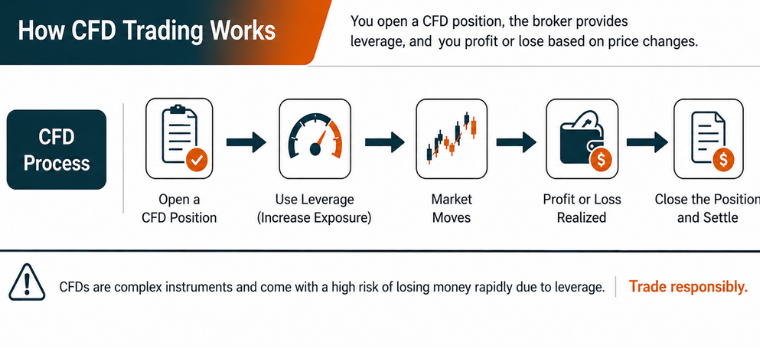
A Contract for Difference (CFD) is a financial derivative used by traders to capitalise on the price movement of an asset without owning it. In a CFD contract, the trader and the broker agree to exchange the difference between an asset's price at the open and at the close.
CFDs are instruments that are used to trade with a broad range of markets, including stocks, indices, cryptocurrencies, forex and commodities. The instrument has become popular among active traders because it provides larger exposure than the deposited amount due to leverage.
Unlike options contracts, CFDs usually do not have a fixed expiry date, so positions can be held as long as margin requirements are met. However, open positions are typically subject to daily overnight financing charges while they remain open.
CFD trading follows a simple directional logic: you buy if you expect the price to rise, you sell if you expect it to fall. Options’ advanced trading strategies can become far more complex, using combinations of calls, puts, multiple strike prices and different expiry dates to create layered positions that profit from a variety of market conditions.
CFDs are complex instruments and come with a high risk of losing money rapidly due to leverage. 60% of retail investor accounts lose money when trading CFDs with this provider. You should consider whether you understand how CFDs work and whether you can afford to take the high risk of losing your money.
Trading CFDs Example
For example, let's consider a trader with a €1,000 account who believes a stock will rise by 5%.
The trader opens a CFD with 5x leverage, taking exposure to €5,000 worth of stock. A 5% gain on the underlying generates a €250 profit, a 25% return on the account balance before costs. If the stock falls 5%, the loss is €250.
There is no fixed expiry to manage. You simply open the CFD position and close it when your trade objective or risk limit is reached, bearing in mind any financing costs
Pros and Cons of Trading CFDs
Pros
- No expiry date, so positions can be held as long as needed
- Simple to use, only need to predict price direction
- Near 24/7 trading on many assets
- Easy to go short (sell) without owning the asset
- Often used by active day traders and short‑term speculators, but not typically suitable for complete beginners because of the high risk associated with leverage
Cons
- Overnight financing charges eat into profits on longer-held positions
- No defined risk ceiling, a sharp market move can cause significant losses
- Margin calls can force positions to close at the worst possible time
Options Trading Basics
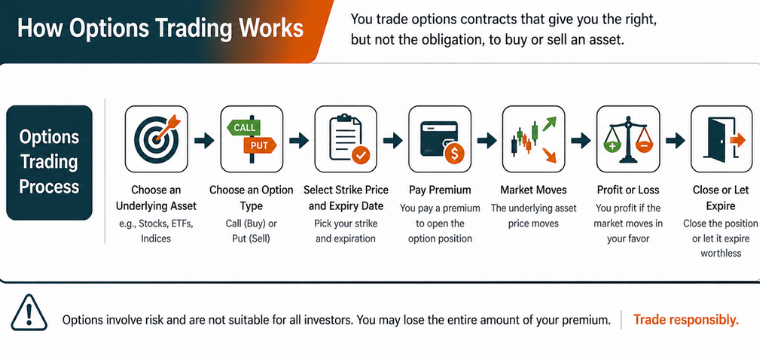
An option is a financial derivative that gives the buyer the right, but not the obligation, to buy (call option) or sell (put option) an underlying asset at a predetermined price, known as the strike price, on or before a specified expiry date.
To secure this right, the buyer pays an upfront fee known as the premium. If the market does not move enough in the expected direction before the contract expires, the option expires worthless, and the buyer loses only the premium.
Options can be used for speculation, hedging and income generation, but they are considerably more involved than CFDs. Pricing is influenced by multiple variables: the option's intrinsic value, how much time remains until expiry, and the current level of implied volatility in the market.
Experienced traders often construct strategies by combining multiple call and put options, such as iron condors or butterfly spreads, which gives them flexibility to profit from different market scenarios.
Options Trading Example
Similar to the CFD example, let's consider a trader with a €1,000 account who believes a stock is going to rise by 5%.
The trader buys a call option for a €100 premium. If the stock rises 5%, the option may increase in value according to the option's delta (multiples of the spot move), but the actual profit depends on time: theta, the time remaining until expiry, implied volatility, and how close the stock price is to the strike. If the stock does not rise enough to cover the premium and other costs before expiry, the option can still expire worthless even if the market moves in the anticipated direction.
Pros and Cons of Options Trading
Pros
- Maximum loss for a buyer is capped at the premium paid
- Can be used for speculation, hedging and income generation
- An effective portfolio hedging tool without giving up upside exposure
- Can profit from volatility alone, regardless of price direction
- Useful for building advanced multi-leg strategies
Cons
- Time decay (theta) erodes option value daily, even if the market does not move
- Require understanding of strike prices, expiry dates, Greeks and implied volatility
- Premiums can expire completely worthless, a 100% loss on the outlay
- Options sellers can face very large, theoretically unlimited losses on uncovered (naked) short positions if the market moves sharply against them
- Less liquid than CFDs on many markets
- Not beginner‑friendly - the learning curve is steep and requires a solid understanding of how options are priced and how risk is managed
What is the cost difference: CFD vs Options Trading
Cost structure is one of the most practically important differences between these two instruments. Neither CFD nor options are categorically cheaper. The real cost depends on trade size, holding period, market conditions and broker fee structure.
CFD Costs
- Spread: The difference between the buy and sell price. For most short-term CFD trades, this is the main cost.
- Overnight financing: A daily charge applied to positions held past market close. Calculated as a percentage of the total position value, this can compound meaningfully over longer holding periods.
- Commission: Some brokers apply a separate commission, particularly on equity CFDs.
- Currency conversion: A fee applied when trading assets in a currency different from the account's base currency.
For a day trader who closes all positions before the end of the session, the spread is often the only cost. For traders who hold overnight, financing charges need to be factored into the equation carefully.
Options Costs
- Commission: Most brokers charge per contract.
- Bid-ask spread: The gap between the market's buy and sell price for the option itself.
- Assignment risk: If a short option is exercised against the seller, additional obligations and costs can arise.
An options premium may look small compared with CFD margin requirements, but a long option that expires worthless still represents a 100% loss of the amount paid for the premium. This is worth keeping in mind when comparing the two instruments on a cost-per-trade basis.
CFD vs Options Trading: Which Has Higher Risk?
Both instruments, CFDs vs options, carry significant risk. But the type of risk and how it behaves is quite different, and this distinction matters enormously in practice.
With CFD trading, risk is directly tied to leverage and price movement. If the market moves sharply against an open position, losses can exceed the initial margin and, in some jurisdictions without negative balance protection, even the account balance, although many regulators now require loss limits for retail clients.
Margin calls are a real concern: if a position moves against the trader and the account falls below the minimum margin, the broker may close the trade or request additional funds. Gap risk adds another layer, if a market opens far higher or lower than it closed due to a news event, there is no opportunity to exit at the previous level.
Options trading carries a different kind of risk depending on which side of the trade you are on. A trader who buys an option cannot lose more than the premium paid, that is, the hard ceiling on downside. Option sellers, however, face a very different exposure: if the market moves sharply in the wrong direction, losses can be substantial and, in theory, unlimited.
Time decay works against buyers, too. As expiry approaches, an option loses value every day even if the underlying asset price does not move.
Volatility also plays a bigger role in options pricing. A spike in implied volatility can dramatically change the value of an options position, for better or worse, independently of what the underlying market is doing.
CFDs are complex instruments and come with a high risk of losing money rapidly due to leverage. 60% of retail investor accounts lose money when trading CFDs with this provider. You should consider whether you understand how CFDs work and whether you can afford to take the high risk of losing your money.
Bottom Line
CFD trading suits traders who want direct market exposure, flexible access across multiple asset classes and a simple execution model. They are primarily used for short‑ and medium‑term strategies, including day trading, swing trading and speculative trading across different asset classes, and they require disciplined risk management and a good understanding of leverage.
Options trading is better suited to experienced traders who need defined-risk exposure, precise hedging tools or the ability to build advanced strategies and multi-leg positions. They require a deeper understanding of derivatives pricing mechanics, and that learning investment should happen before capital is put at risk.
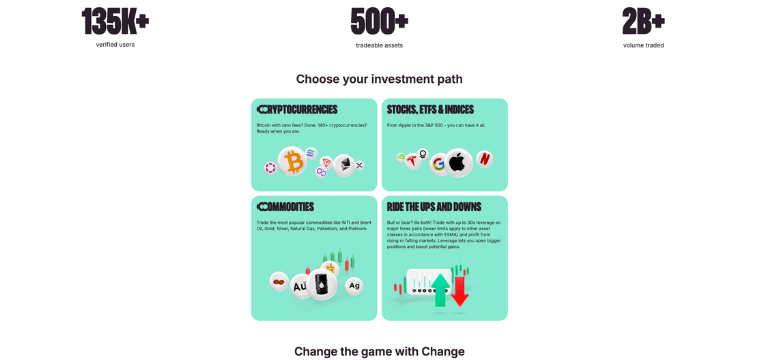
Neither instrument is universally superior. The right choice depends on trading objectives, experience level, holding period and the risk a trader is willing to carry on each position. For those who want a clean, low-barrier way into CFD trading across crypto, forex, stocks and commodities, Changs’s trading platform provides a single, integrated environment to manage their positions.
Frequently Asked Questions
Is CFD trading riskier than options trading?
Both CFD and options trading are high-risk, but CFDs can expose traders to unlimited losses if risk management is not used.
Which is better for beginners: CFDs vs options?
CFDs are generally easier to understand, while options require knowledge of strike prices, premiums, and expiry dates.
Are CFDs cheaper than options to trade?
CFDs often have lower upfront costs because you only post margin, but overnight financing fees and spreads can significantly increase the total cost of trading over time.
Can you lose more money than you invest with CFDs or options?
With CFDs, losses can exceed your initial margin and may be substantial if markets move quickly against you, although some brokers offer negative balance protection. Option buyers, by contrast, can lose only the premium paid.
What is the main difference between CFDs and options?
CFDs track price movements directly, whereas options give the right, but not the obligation, to buy or sell an asset.