The global financial market offers a variety of tradable instruments, but two of the most exciting and highly traded instruments are crypto and forex. Most new investors, when starting, get confused about whether to choose cryptocurrency or forex trading.
Both markets are massive in trading volume, measured in the trillions, but they operate in vastly different ecosystems: one trades global currency pairs, while the other is driven by assets built on new-age blockchain technologies.
This guide will discuss forex and crypto trading in detail, so you can decide which market aligns better with your risk tolerance and goals.
Key Overview
- Crypto trading is the buying and selling of digital currencies; the markets run 24/7, are highly volatile, and untethered from government oversight.
- Forex trading is the world's largest trading market by volume, more stable day-to-day, but traditionally tied to larger capital requirements and structured trading hours.
What Is Cryptocurrency Trading?
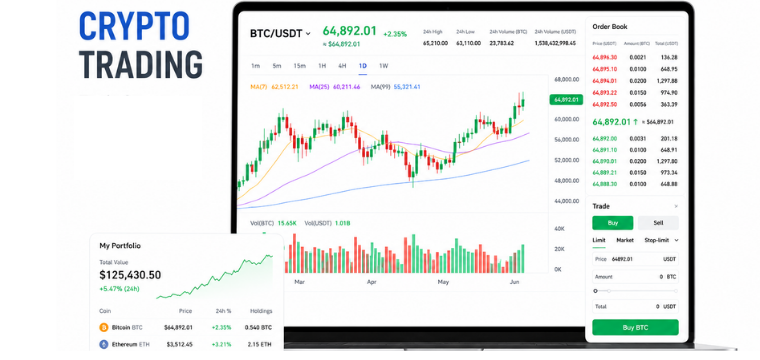
Cryptocurrency trading is the buying and selling of digital assets such as Bitcoin, Ethereum, and hundreds of other altcoins within the blockchain space. The aim of a crypto trader is to profit from price changes of these virtual assets. The volatility in crypto trading is extreme, with prices fluctuating wildly within minutes.
Virtual assets are unlike traditional currencies; cryptocurrencies are decentralised. While traditional assets, like stocks and forex, are subject to government regulation, crypto supply is not backed by a central bank or government.
According to a report by ARK Invest, the crypto market capitalisation is projected to reach $16 trillion in 2030, building on a current market cap of approximately $3.2 trillion as of mid-2026.
Types of crypto trading
- Spot Trading: Spot trading is the most straightforward form of crypto trading. You buy or sell a cryptocurrency at its current market price and take direct ownership of the asset. It is the most popular starting point for beginners and suits investors who want to hold crypto long-term or trade it without the complexity of derivatives.
- Futures Trading: Crypto futures allow you to agree to buy or sell a cryptocurrency at a predetermined price on a future date, letting you speculate on price direction without owning the underlying asset. Futures are commonly used to hedge existing positions or amplify exposure through leverage, though they carry significantly higher risk than spot trading.
- CFD Trading: Crypto CFDs let you trade on the price movement of a cryptocurrency, up or down, without taking ownership of the coin itself. Crypto CFDs are a flexible way to gain market exposure quickly, allowing you to go long or short depending on your market view.
Advantages of Cryptocurrency Trading
- High growth potential: While it carries increased risk, high volatility could be a significant edge with proper risk management. The rapid-growth opportunity that could generate life-changing gains in a short period remains limited in traditional markets like Forex.
- Round-the-clock trading: Cryptocurrency trading is always open 24/7/365. The market doesn’t take any holidays and never closes on weekends. Traders can act on movements they want at any time of day, without worrying about opening or closing positions.
- Self-custody: Cryptocurrency is a new-age currency not governed by governments or financial institutions, enabling users to maintain self-custody through private keys and hardware wallets. It means that you have complete control over your funds.
- Low barrier: What makes crypto trading especially appealing for beginners is the low barrier to entry. You don't need thousands of euros to participate; with secure crypto platforms like Change, you can start from as little as €10 and buy fractions of major coins.
Disadvantages of Cryptocurrency Trading
- High risk: As mentioned earlier, high volatility is a double-edged sword. While it increases profit potential, it can also harm a trader's portfolio in a single day if the risk is not managed properly. Even leading cryptocurrencies have faced drawdowns of over 90% during bear markets.
- Regulatory Uncertainty: Government bodies worldwide have been working to establish a strict framework for crypto trading, but many issues remain unresolved. The uncertainty remains difficult for traders to navigate, as developments might significantly affect their portfolios.
- Irreversible errors: Crypto gives people full control over their money, but a single forgotten password or recovery phrase can lock funds away forever. While in a traditional financial system, the funds can be recovered, crypto platforms usually cannot reverse mistakes.
What Is Forex Trading?
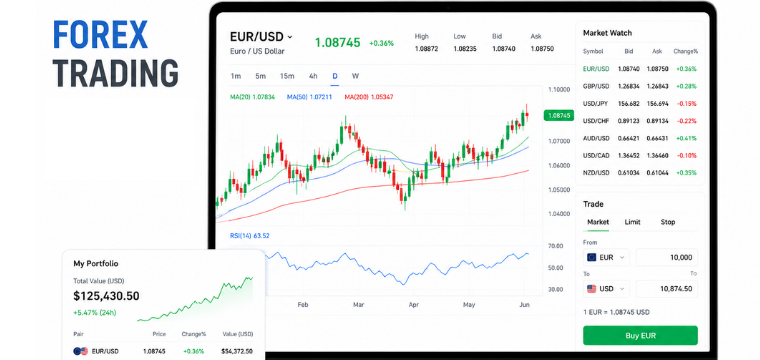
Forex trading is the buying and selling of currency pairs, like EUR/USD, GBP/CZK, or USD/JPY, to profit from movements in the foreign exchange market. The Forex market is one of the largest trading markets in the world, with daily trading volume exceeding approximately $7.5 trillion.
Unlike crypto, which is decentralised, the forex market operates through a global network of banks, institutions, hedge funds and brokers, making it a major financial hub. In contrast to the crypto market, the forex market's volatility is very low due to deep liquidity and small increments and decrements between currencies.
Smaller short-term opportunities for retail investors are hard to capitalise on unless leverage is involved; they can access them through broker platforms and trade instruments like CFDs or futures.
Types of Forex Trading
- Spot Forex Trading: Spot forex trading involves buying one currency and simultaneously selling another at the current exchange rate, with the transaction settled immediately.
- Forex CFD Trading Forex CFDs allow you to speculate on currency pair price movements without exchanging actual currencies, offering flexible access to major pairs like EUR/USD or GBP/USD through a single trading platform. CFDs also allow the use of leverage, which means you can control a larger position with a smaller deposit, increasing both potential gains and potential losses.
Change is built exactly for investors who want access to both worlds. Operating under the EU's Markets in Financial Instruments Directive (MiFID II) and fully licensed under the EU’s Markets in Crypto-Assets (MiCA) regulation by the Dutch Authority for the Financial Markets (AFM), the platform provides access to over 140 cryptocurrencies alongside global stock, commodity, and forex CFDs - all from a single mobile app. You can buy crypto in seconds, set up recurring buys, earn staking rewards, and explore CFD markets without switching platforms.
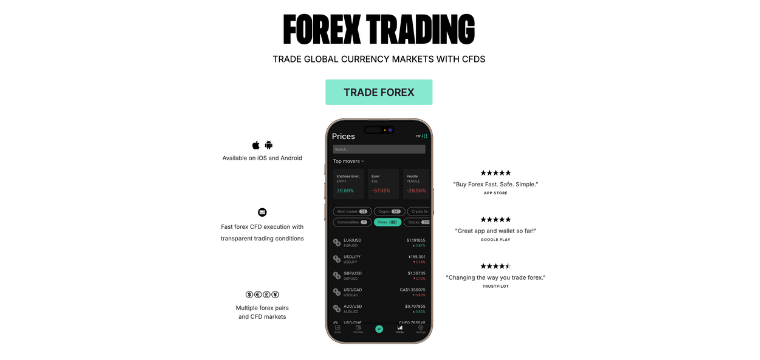
You can buy crypto in seconds, set up recurring buys, earn staking rewards, and explore CFD markets without switching platforms. With real customers since 2010, the platform is built on a decade of trust.
- Futures: A forex futures contract locks in an exchange rate for a transaction to take place at a specific future date; it is commonly used by businesses to hedge against currency risk.
While less common among retail investors, forwards are a useful tool for anyone with predictable foreign currency needs looking to protect against adverse rate movements.
Advantages of Forex Trading
- Deep liquidity: Strong liquidity is a trader’s paradise; it attracts massive institutional funds, and traders can enter and exit very smoothly without any slippage. With strong liquidity, the market also offers stability, allowing traders to execute large positions.
- Regulatory protection: While the crypto market remains prone to phishing scams and hacks, the forex market benefits from sophisticated regulatory oversight. Regulated brokers around the world safeguard your funds, providing protections such as strict security, insurance, and dispute resolution.
- Advanced trading tools: Various brokers now provide institutional-grade trading infrastructure to retail traders. Top brokers now execute trades in under a millisecond while offering powerful charting tools and advanced algorithmic trading features for better trading efficiency.
Disadvantages of Forex Trading
- Limited profit potential: While the forex market offers deep liquidity, volatility is very low, with major currency pairs moving less than 1% in a day. Fx traders benefit from massive position sizing and high churn, which frustrates traders who want to trade momentum.
- Institutional competition: The Forex market is dominated by highly valued institutions that employ advanced algorithmic trading strategies, making it hard for retail traders to compete. Their actions often disrupt normal market patterns, making price moves harder to predict and leaving retail traders confused about why trades suddenly turn against them.
- Leverage disadvantages: While EU regulation (ESMA) caps retail leverage at 30:1 on major currency pairs, even this level carries serious risk. Many retail forex traders lose money due to overleveraging, often driven by impatience or overconfidence.
Forex vs crypto: Key Differences Explained
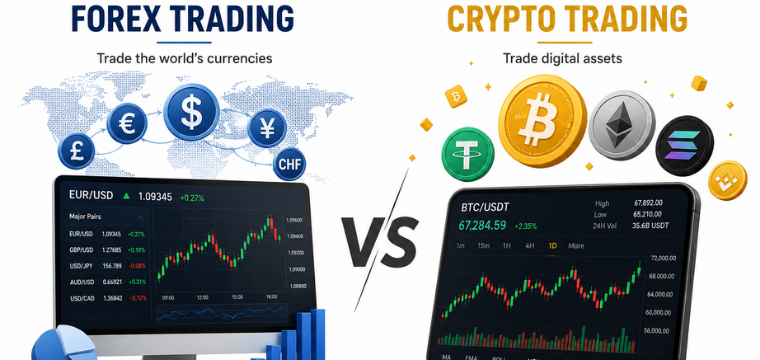
Understanding the structural differences between these forex and crypto trading markets makes it much easier to decide how they fit into your investment approach.
1. Market Hours and Accessibility
The crypto market never sleeps; it is open 24/7, 365 days a year, including weekends and public holidays. This is especially flexible for those who wish to trade around a job, family, or any other work commitment.
Although Forex is a 24-hour market during the week, it is organised into trading sessions that overlap throughout the trading day in Tokyo, London, New York, and Sydney. While European investors can trade most variants, the most active and liquid trading window is the London–New York overlap (roughly 14:00–17:00 CEST). The forex market is completely closed on weekends.
Crypto being 24/7 is a real boon for flexibility, but it also means price movements can occur at any hour, including during your sleep. The healthiest approach is to have a long-term strategy or simply check your prices every day instead of checking your prices every day.
2. Volatility and Risk Tolerance
Crypto is much more volatile than forex. Bitcoin can move 5–10% in a single day; in really active, sky-high heads, it may even move more. However, this could be a double-edged sword, increasing both profits and losses.
Major forex pairs such as EUR/USD usually do not move by more than 1% in a normal trading day. This makes sense for certain strategies, but it also means that true short-term returns are typically driven by leverage.
Forex CFD trading has its own risk profile (especially with leverage), and this is the same whether it's forex or a stock position on many platforms. Be careful with this if you are a beginner.
Whether markets rally or languish, a well-articulated strategy will be more valuable than making the correct call on where to put money to work at any point in time.
3. Entry Costs and Fee Structures
This is one area where crypto has a major advantage for beginner investors. Fractional ownership means you do not need to buy an entire Bitcoin. You can start a position with just €1.
While forex CFDs can also have low minimums, fee structures are likely to be more complicated. There might also be spreads, overnight financing charges (swap rates) and commission fees on some platforms. Crypto costs are usually either a spread or a one-off transaction fee, making them easier to track on-chain.
Regardless of the market you are looking to invest in, be sure to read a platform's full fees before signing up. No hidden rates, no confusing rate structures, and no fine print are signs of a reputable service provider.
Which Is Better for Beginner Investors?
There is no single right answer, and that's not a cop-out; it genuinely depends on your goals, your risk tolerance, and how much time you want to spend actively managing your portfolio.
Crypto tends to suit beginners who:
- Want to start small without feeling locked into large positions
- Prefer a simple, mobile-first experience over complex trading terminals
- Are building wealth gradually through automated strategies like DCA
- Want passive income potential through staking while they hold
- Are drawn to a fast-growing asset class with long-term potential
Forex may be a better fit for investors who:
- Prefer more predictable, lower-volatility price movements
- Want to speculate on global macroeconomic events like central bank decisions or inflation data
- Comfortable with how leverage and CFD mechanics work
Bottom Line
Deciding between crypto and forex trading is not an either-or choice. Crypto offers easy access, 24/7 trading, and passive income opportunities such as staking, whereas the forex market is more structured and less volatile. Depending on the type of investment, both play a role in a balanced portfolio.
The key is to start small, invest regularly, and minimise unnecessary costs. Long-term wealth is most often built by staying invested and managing risk well - not by chasing the perfect trade. Platforms like Change are designed around exactly that philosophy, giving you access to both crypto and CFD markets with transparent fees, low minimums, and no platform-switching required.
Frequently Asked Questions
Is crypto trading better than forex trading for beginners?
Crypto trading is often easier for beginners because it allows small investments, simple apps, and 24/7 access. Forex is more structured but usually requires a stronger understanding of leverage and market movements.
What is the main difference between the forex and crypto markets?
Crypto trading involves digital assets like Bitcoin, while forex trading focuses on currency pairs like EUR/USD. Crypto is more volatile, whereas forex is generally more stable.
Which market is riskier: Forex vs crypto trading?
Crypto is usually riskier because prices can swing sharply within hours. Forex tends to be less volatile, but high leverage can still lead to significant losses.
Can you trade crypto and forex with a small amount of money with risk management?
Yes, both markets allow small starting amounts, but crypto platforms often let users begin with as little as €1 or €10 through fractional investing.
Is Forex market trading more profitable than crypto trading?
Profitability depends on strategy, risk management, and market conditions. Crypto offers higher growth potential, while forex provides more stable but smaller price movements.