CFDs (contracts for difference) and ETFs (exchange-traded funds) are two of the most popular financial instruments used by traders and investors to capitalize on market movements. While CFDs allow trading without owning the underlying asset, ETFs represent ownership of a fund holding real assets.
CFDs track the price movements of different assets while providing traders with leverage. On the other hand, ETFs are baskets of underlying assets such as stocks, bonds, or commodities, providing investors with diversification.
Another crucial difference is that ETFs are listed and traded on regulated stock exchanges, whereas CFDs are traded on an over-the-counter (OTC) market, where trading is conducted over-the-counter through brokers.
Understanding how they differ in price movements, costs, and risks can significantly impact your trading and help you develop a better trading plan and approach. In this article, we're exactly doing that, diving deep into the mechanics of CFDs and ETFs.
Key Takeaways
- CFDs are leveraged derivatives for short-term speculation, while ETFs are exchange-listed funds that hold real assets and are better suited to long-term investing.
- The right choice depends on your time horizon, risk tolerance, and whether you want to trade actively or invest passively.
CFD vs ETF: Key Differences Explained
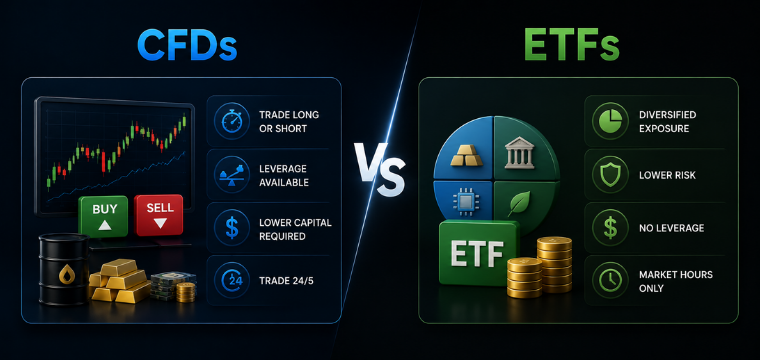
The core differences between CFDs and ETFs come down to five factors: ownership, leverage, cost, risk, and purpose. Each of these factors helps determine whether an instrument is suitable for a given strategy.
Ownership is the most fundamental distinction. ETF investors hold actual units in a fund. CFD traders hold a contract; there is no underlying asset, no voting rights, and no direct claim to dividends, although dividend adjustments may be reflected in CFD pricing.
Leverage separates the two instruments in terms of risk profile. Most ETFs are unleveraged: you invest the full amount, and your maximum loss is generally limited to the amount invested (excluding rare structural risks). CFDs use margin, meaning a relatively small deposit can control a much larger position.
Cost structure differs significantly between the two instruments over time. CFDs can be cost-efficient for short-term trading - the main cost is the spread, but overnight financing charges compound quickly on longer-held positions. ETFs typically have a low annual expense ratio and no overnight financing costs, making them more cost-efficient for investors holding positions over weeks, months, or years.
Purpose is perhaps the clearest line of all. CFDs are primarily used for short-term speculation and active trading. ETFs are commonly used for long-term investing and portfolio building. The right tool depends entirely on which of those two activities aligns with your financial goals.
CFD vs ETF at a Glance
What Is a CFD?
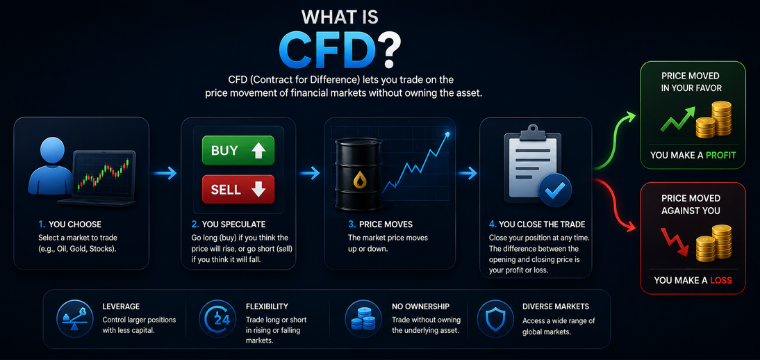
A Contract for Difference (CFD) is a derivative product popular among active traders, as it allows them to speculate on an asset's price movement without owning it. You open a position with a CFD broker, and profit or loss is determined by how far the asset moves from your entry point to your exit point.
CFDs can be traded across multiple asset classes, including stocks, indices, forex, commodities, and cryptocurrencies CFDs. One of the main benefits of CFDs is that they provide leverage, meaning a small initial deposit controls a much larger position. This amplifies both potential gains and potential losses in equal measure.
Unlike other derivative products like Futures and options, CFDs don’t have any fixed expiry date. As a trader, you can hold positions for minutes, hours, or days, with an overnight financing charge applied to any position kept open past market close.
CFDs are complex instruments and come with a high risk of losing money rapidly due to leverage. 60% of retail investor accounts lose money when trading CFDs with this provider. You should consider whether you understand how CFDs work and whether you can afford to take the high risk of losing your money.
How CFDs Function
The working of a CFD contract is very simple as it is based on the difference between the opening and closing prices of an asset. You can trade in both buy and sell directions according to your analysis and trading approach.
For example, consider a trader starting with €1,000 and wanting to gain exposure to the same index. He opens an index CFD with 10x leverage, controlling €10,000 of market exposure. A 5% rise in the index generates €500 profit, a 50% return on the €1,000 account. A 5% fall generates a €500 loss, wiping out half the retail investor account. Daily financing charges apply if the position is held overnight.
Pros and Cons
What is an ETF (Exchange Traded Fund)?
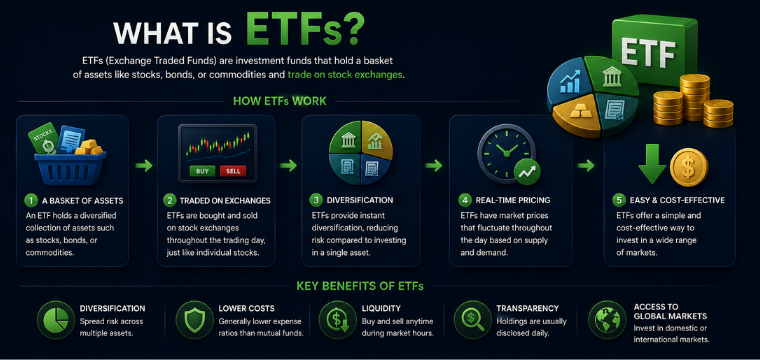
An Exchange-Traded Fund (ETF) is a pooled investment vehicle that holds a basket of underlying assets, such as stocks, bonds, or commodities, and trades on a regulated stock exchange just like a share. When you buy an ETF, you own units in the fund and have indirect exposure to everything it holds.
Unlike CFDs, ETFs are primarily investment tools, although they can also be actively traded. However, major ETFs are used for active trading in various developed markets.
In the investment world, ETFs are typically used by investors seeking diversified, low-cost exposure to a market, index, or sector without having to pick individual stocks. A single ETF tracking the S&P 500, for example, gives you exposure to 500 companies through one purchase.
For EU investors, the most relevant ETF structure is the UCITS ETF, a regulatory framework designed specifically for European retail investors that requires diversification, disclosure, and strong investor protection standards. If you want a deeper breakdown of how to access global indices through both CFDs and ETFs, the Changeiguide on how to invest in the S&P 500 as a European investor covers this in full.
Types of ETFs
There are several kinds of ETFs that are simple for funds to create, as they are just baskets of different assets:
- Index ETFs: Track a market index such as the S&P 500, DAX or MSCI World, giving broad market exposure through a single fund
- Sector ETFs: Focus on a specific industry such as technology, healthcare or energy
- Commodity ETFs: Track the price of physical commodities like gold, oil or silver
- Bond ETFs: Hold a basket of fixed-income securities such as government or corporate bonds
- Crypto ETFs: Track the price of cryptocurrencies like Bitcoin (availability depends on region - in the EU typically via ETPs)
- Dividend ETFs: Focus on companies with strong, consistent dividend payouts, suitable for income-focused investors
- Geographic ETFs: Provide exposure to specific regions or countries, such as emerging markets or European equities, including emerging and developed markets
- Leveraged ETFs: Use derivatives to amplify daily returns, typically reset daily, carrying significantly higher risk than standard ETFs
- Inverse ETFs: Designed to profit when a market falls, often used for short-term hedging
Pros and Cons
CFD vs ETF Costs Explained
The cost comparison between CFDs and ETFs is not as simple as one being cheaper than the other; it depends heavily on how long the position is held.
For short-term trading, CFDs can be cost-efficient, especially when positions are not held overnight. The spread is often the only cost incurred, and it is relatively tight on liquid markets. To understand exactly how spreads affect your trading costs, the Changeguide on what spreads are and how they work breaks it down clearly.
For a position held overnight or over multiple days, overnight financing charges begin to accrue. These are calculated daily as a percentage of the total trade position value, which, because of leverage, can be substantially larger than the initial margin deposit.
CFD Cost Structure
The main costs when trading CFDs are:
- Spread: The gap between the buy and sell price. The primary entry and exit cost for most CFD trades.
- Overnight financing: A daily charge on positions held past market close. Calculated on the full position size, not just the margin.
- Commission: Some brokers charge an additional fee, particularly on equity CFDs.
- Currency conversion: A fee applied when the underlying asset is priced in a different currency than the account base.
ETF Cost Structure
The main costs when investing in ETFs are:
- Expense ratio (TER): An annual management fee deducted from the fund's value. For large index-tracking UCITS ETFs, this typically ranges between 0.07% and 0.25% per year.
- Brokerage commission: A one-time fee to buy or sell ETF shares, charged by the platform.
- Bid-ask spread: The gap between the ETF's buy and sell price on the exchange.
For a long-term investor, a 0.15% annual expense ratio compounds slowly and is generally considered low. For a CFD trader holding a position over extended periods, daily overnight financing charges would vastly outweigh any other cost consideration.
CFD vs ETF for Day Trading
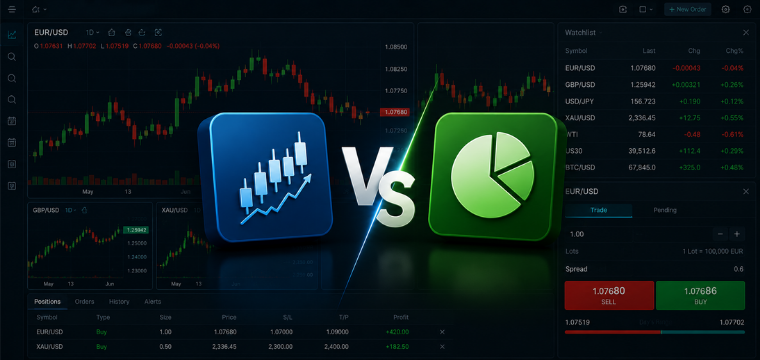
For day trading, CFDs are a considerably better instrument. They offer leverage, tight spreads on liquid markets, no fixed expiry date, and near-24-hour access across forex, indices, commodities, and crypto. A day trader can open and close multiple positions within a session without incurring overnight financing charges.
ETFs are tradable during market hours, but are generally less suited for high-frequency intraday trading compared to leveraged instruments. There is no built-in leverage, spreads can widen during volatile sessions, and the cost efficiency that makes ETFs attractive for long-term investors does not translate to high-frequency, short-duration trades.
CFD and ETF: Which is Better
CFDs are particularly useful when speed, flexibility, and capital efficiency matter. Day traders benefit from fast execution and no overnight financing when closing positions within the session, while swing traders can hold positions open for several days without a fixed expiry date.
ETFs serve a fundamentally different purpose and suit a different type of market participant. They are widely used by investors building long-term portfolios through regular, disciplined contributions, because compounding works best when costs are low, diversification is built in, and positions can be left alone to grow.
The clearest way to think about the distinction is in terms of time horizon. If the goal is to capture a price move over the next few hours or days, CFDs are almost always the more practical tool. If the goal is to grow wealth steadily over months or years without daily monitoring or leveraging risk, ETFs are the structurally better fit.
Bottom Line
CFDs and ETFs are not competitors, they are rather different tools designed for different jobs. Using the wrong instrument for your objective can lead to inefficient results. ETFs are the right foundation for most retail investors seeking to build long-term wealth. They are transparent, generally low-cost, and designed for long-term holding within regulated frameworks.
For traders who want short-term market exposure with leverage across crypto, forex, stocks, and indices, all from a single regulated platform, Change provides a streamlined platform for accessing leveraged CFD trading across multiple asset classes.
Frequently Asked Questions
Is a CFD better than an ETF?
It depends. CFDs suit short-term leveraged trading, while ETFs are generally better for long-term investing.
Can you lose more money with CFDs than ETFs?
Yes, CFDs use leverage, so losses can exceed those from investing in an ETF. With CFDs, losses can exceed your initial margin in some cases, although many EU brokers provide negative balance protection.
Do CFDs track the price of ETFs?
Yes, CFD providers often offer CFDs that mirror the price movements of underlying ETFs.
Are ETFs safer than CFDs?
Generally, yes, because most ETFs are unleveraged investment funds, while CFDs are leveraged derivatives with higher risk. However, risk depends on how each instrument is used.
Which is more suitable for beginners: CFDs or ETFs?
ETFs are usually more beginner-friendly due to their lower risk and simpler investment structure. However, for traders, CFDs are a suitable choice.