In trading, each instrument comes with specific advantages and disadvantages, and to get started, you need to understand which suits you best. This is the confusion that arises when deciding whether to focus on CFDs (contracts for difference) or on the underlying stocks.
Buying a stock gives you real ownership in a company, while a CFD is a derivative contract that lets you speculate on price movements without owning the underlying asset. CFDs offer leverage and the ability to short-sell, but they carry significantly more risk than traditional stock investing.
But before trading these instruments, it is crucial that you understand the difference. This guide covers everything from key differences between CFD vs stock to costs, so you can make the right decision.
Key Takeaways
- Stocks represent actual ownership in a company, while CFDs are contracts that mirror price movements without conferring ownership.
- CFDs use leverage, which amplifies both profits and losses, making them suitable for active traders, while stocks are mostly used for long-term investing.
CFD vs Stocks: What's the Difference?
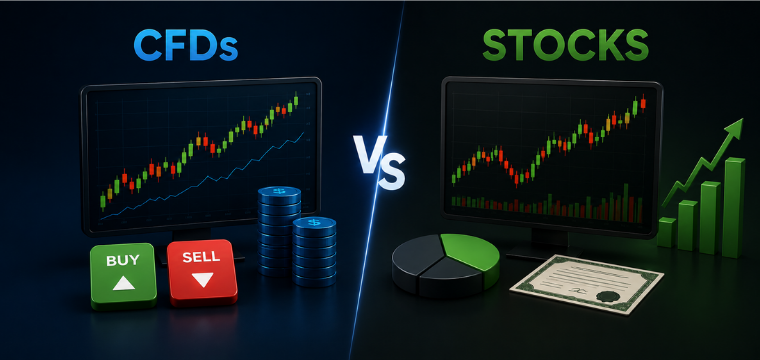
The most important difference between CFDs (contracts for difference) and stocks is the ownership of the underlying asset. When you buy a stock, you become a shareholder in a company. You hold a real asset, you may receive dividends, and you can hold that position indefinitely without incurring ongoing charges.
However, a CFD is a different ballgame from stocks. Instead of owning the underlying asset, you get a contract with a broker to exchange the difference in the price of that asset between when you open and when you close your position. No shares change hands, no ownership is conferred, and the contract exists purely to track price movement.
CFDs are leveraged products and were originally developed for institutional traders looking to hedge positions without paying stamp duty or physically acquiring assets. They are now widely available to retail investors through online trading platforms, and they cover a broad range of markets: stocks, indices, commodities, forex, and crypto.
CFD vs Stocks: Key Differences
How CFDs Work
To understand it simply, CFD is a derivative contract between you and a broker. When you enter into a contract, you agree to exchange the difference between the price of a chosen asset at the time the contract opens and at the time it closes. If the price moves in your favour, you collect the difference, and if it moves against you, you pay it.
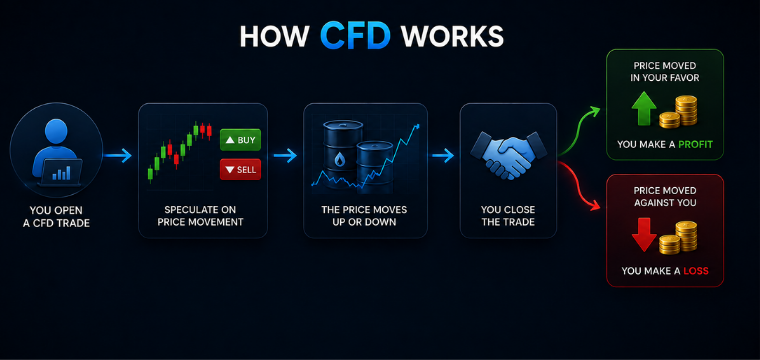
What’s important to understand with trading CFDs is leverage. You don't need to put up the full trade value of the initial investment. Instead, you just put a deposit as a margin, a percentage of the total trade value, and your broker funds the rest.
CFDs are complex instruments and come with a high risk of losing money rapidly due to leverage. 60% of retail investor accounts lose money when trading CFDs with this provider. You should consider whether you understand how CFDs work and whether you can afford to take the high risk of losing your money.
Leverage and Margin in Practice
For example, if a broker offers 10:1 leverage, you can control a €10,000 position with just €1,000 of your own money. While this may sound exciting, leverage is a double-edged sword; it can increase profit potential but also increase losses.
A 5% move in your favour doubles your margin, while a 5% move against you wipes it out entirely.
Under EU regulations set by the European Securities and Markets Authority (ESMA), leverage for retail clients is capped depending on the asset class: 30:1 on major currency pairs, 20:1 on major indices, 10:1 on minor indices and non-gold commodities, 5:1 on individual equities, and 2:1 on crypto CFDs. These caps exist for a reason; leverage amplifies losses just as readily as it amplifies gains, and regulators introduced these limits specifically to protect retail traders.
Trading CFDs Example
You open a CFD on a stock priced at €100, buying 100 units (total position value: €10,000). With 10:1 leverage, your required margin is €1,000.
- The stock rises 10% - €110. Your profit - €1,000.
You've doubled your margin. - The stock falls 10% - €90. Your loss - €1,000.
Your entire margin is gone.
Same price movement, very different outcomes depending on whether leverage is in play.
Pros and Cons of Trading CFDs
Pros:
- Access to leverage, enabling larger market exposure with smaller capital
- Ability to profit from both rising or falling prices
- Access to a wide range of asset classes from a single account
- No stamp duty in markets where this applies to stock purchases
Cons:
- Losses can exceed your initial deposit when leverage is used
- Overnight financing charges make long-term holding expensive
- No ownership of the underlying asset
- No actual dividends or shareholder voting rights
- Higher complexity due to market volatility, active risk management is essential
How Stocks Work
Buying a stock has become a traditional investment method and is one of the simplest investment options available. You purchase shares in a company through a stock exchange, and your stocks represent ownership.
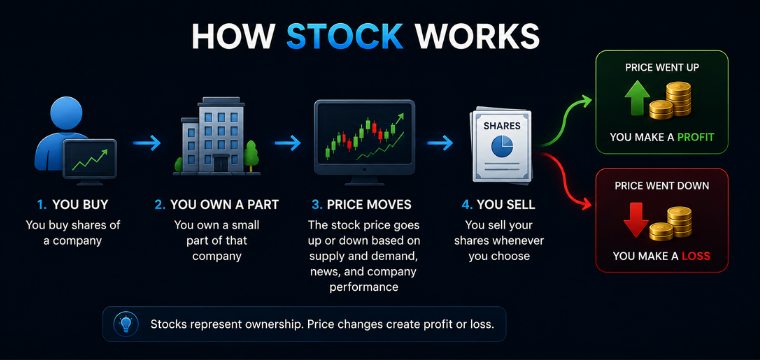
If the company's performance makes progress, the price appreciation occurs, and the share price rises, you make a profit. But if the company shows no growth or a decline in growth, the share price drops, and you might lose some of your investment, they also depends on market conditions. If the company pays dividends, you receive those payments directly.
Ownership, Dividends and Long-Term Value
Unlike CFDs, underlying shares carry genuine rights for you as a shareholder in a company. As a shareholder, you may receive dividends, regular payments distributed from company profits, and, depending on the share class, you may have voting rights on significant company decisions.
There are no overnight financing fees, no margin calls, and no risk of losing more than you put in. If a company's share price falls to zero, an extreme and uncommon scenario, you lose what you invested, and nothing more. For most long-term investors, that simplicity and predictability is the whole point.
Traditional stock trading also benefits from compounding over time. Reinvesting dividends and holding through market cycles is how most long-term wealth is built, not through short-term trading, and not through derivatives.
Many modern platforms offer stock CFDs across multiple markets for trading. Change is one of the top platforms where traders can start trading CFDs on stocks CFDs, as well as on assets like crypto, forex, and commodities.
Pros and Cons of Stock Trading
Pros:
- Direct share ownership with genuine shareholder rights
- No overnight fees, margin requirements or financing charges
- Maximum loss is capped at the amount you invest
- Eligible for actual dividends and compounding growth
- Well-suited for long-term, low-maintenance wealth building
- Stock trading is simpler and more accessible for beginners
Cons:
- Difficult to profit from a falling market sentiment without additional instruments
- Some international brokers offer lower trading fees on global stocks, but capital gains tax still applies depending on your country of residence. Requires patience, stock returns accumulate over years, not days
- Stock trading provides less flexibility for short-term trading strategies
CFD vs Stocks: Which Is Riskier?
High risk comes with high rewards, and that’s why CFDs are significantly riskier than trading stocks because of leverage. A leveraged position doesn't just magnify your gains; it magnifies your losses at exactly the same ratio. Combine that with the psychological pressure of short-term trading, and it becomes clear why retail investor accounts in CFD trading have such a high rate of loss.
However, stocks carry market risk as well, your investment can fall in value, sometimes sharply, but the risk is structurally bounded. You cannot lose more than you invest. And historically, diversified global equity markets have recovered from downturns and delivered long-term positive returns for patient investors.
There's also the matter of margin calls. With a stock portfolio, a bad month is uncomfortable. With a leveraged short or long CFD position, a bad week can close your position automatically and return nothing.
CFD vs Stock Trading: Cost Comparison
The cost structures of CFDs and stocks differ significantly, and understanding them is essential before you trade either:
CFD Trading Costs
The costs of trading CFDs include several components that don't apply to direct stock ownership:
- Spread: The gap between the buy and sell price. This is the primary way CFD brokers generate revenue. Tighter spreads mean lower trading costs, but they still apply to every trade.
- Overnight financing charge: The highest ongoing cost of CFD trading. Each night you hold a position open, you pay a financing fee based on a benchmark interest rate plus a broker margin. Over weeks or months, this erodes profitability significantly.
- Commission: Some CFD platforms charge a commission per trade on top of the spread; many do not.
- Currency conversion: If you're trading assets priced in a different currency, conversion costs may apply.
Stock Trading Costs
Costs for direct stock ownership are generally lower for long-term investors:
- Brokerage fees: Many modern platforms offer commission-free stock trading, though some charge a flat fee or a small percentage per transaction.
- Exchange or custody fees: In some markets, exchange-level charges are passed on to the investor.
- Taxes: Most EU countries have a capital gain tax on stock sales. Dividend income may also be subject to withholding tax depending on your country of residence.
For very short-term trades, held for hours or a single session, trading CFDs can be cost-competitive because spreads are tight and no stamp duty or ownership costs apply. But for any position held for longer than a few weeks, overnight financing makes trading CFDs considerably more expensive than simply owning the stock outright.
CFD vs Stocks for Day Trading
For active day traders, CFD trading often has a genuine edge. Leverage allows you to control larger positions with smaller capital. Short-selling means you can profit when prices fall, not just when they rise. And because a day trader opens and closes positions within the same session, overnight financing costs are irrelevant.
CFDs also give traders access to multiple asset classes, stocks, indices, forex, commodities, and crypto, all from a single account. For someone who wants to trade European equities in the morning, gold in the afternoon, and currency pairs in the evening, that breadth of access from one platform is a real advantage.
That said, day trading is genuinely hard. The combination of fast markets, leverage, and the psychological pressure of real-time decisions means most retail day traders do not generate sustainable profits over time. It's worth being honest about that before treating CFD trading as a primary source of income.
CFDs are complex instruments and come with a high risk of losing money rapidly due to leverage. 60% of retail investor accounts lose money when trading CFDs with this provider. You should consider whether you understand how CFDs work and whether you can afford to take the high risk of losing your money.
CFD vs Stocks: Which Is Better?
Neither product is universally better, it all comes to your trading goals, position sizing and risk appetite. Here's a clear framework to help you decide.
Choose stocks if you:
- Are new to investing and want to learn without taking on outsized risk
- Are you building long-term wealth over years or decades
- Want to receive dividends and benefit from company growth
- Prefer a low-maintenance approach without daily monitoring
- Want to limit your maximum possible loss to what you invest
Choose CFD trading if you:
- Are an experienced trader with a solid past performance and understanding of leverage
- Want to profit from short-term price movements in either direction
- Need access to multiple asset classes from a single account
- Are comfortable with active risk management and position sizing
- Understand that the majority of retail CFD traders lose money
Many investors use both a long-term stock portfolio for steady wealth building, with CFDs used tactically for shorter-term opportunities. If you want to explore both options from one place, Change gives you access to stocks, indices, commodities, and crypto CFDs, all from one simple app.
Frequently Asked Questions
Is CFD trading riskier than stock market investing?
Yes, CFDs are generally riskier because leverage can magnify both profits and losses.
Do you own the underlying asset when trading CFDs?
No, CFD traders speculate on price movements without owning the actual asset.
Are CFDs cheaper than share trading?
CFDs often require less upfront capital, but overnight and spread costs can add up.
Which is better for long-term investing: CFDs vs stocks?
Stocks are usually better for long-term investing due to ownership benefits and lower holding costs.
Can you lose more money than your initial deposit with CFDs?
Change provides negative balance protection, so you cannot lose more than your account balance. CFDs are high-risk: 60% of retail investor accounts lose money trading CFDs with this provider