Artificial Intelligence (AI) is reshaping sectors worldwide, and the financial markets are no exception. AI now affects how markets operate, as tools once reserved for institutional trading desks are within reach of everyday investors.
However, the AI trading space is crowded with noise: exaggerated platform claims, confusing jargon, and systems that promise more than they ever deliver.
In this article, we have tried to simplify it all. Here we discuss exactly what AI trading is, how it works, where it genuinely helps beginners, and where it falls short.
Key Takeaways
- AI trading uses artificial intelligence and machine learning to analyze market data, identify patterns, and in some systems, automate trade execution.
- Beginners can use AI trading platforms and tools, but a solid understanding of trading fundamentals and risk management remains essential regardless of the technology involved.
What is AI trading?
AI trading is the use of artificial intelligence and machine learning to analyze market data, identify patterns, generate trading signals and, in some systems, automate trade execution. It is not the same as simply using an AI trading app or drawing lines on a chart manually.
The amount of information AI can handle at once is much larger than humans. However, the idea is not that AI knows where prices are going, but that it can quickly find signals that may point to a possible trading opportunity.
Three terms get used interchangeably in this space, but they mean different things:
- AI trading uses machine learning models that can learn from new data and, in some cases, adapt their behavior.
- Algorithmic trading follows predefined, rule-based logic that does not learn or adapt independently.
- Automated trading refers to any system that executes trades without manual input, which may or may not involve genuine AI.
Not all automated systems are AI. Not all AI systems are fully automated. Understanding this distinction is one of the most important things a beginner can do before choosing any tool.
How does AI trading work?
AI trading systems work through a set process, even when everything happens in milliseconds behind the scenes. Each step affects the next, so a problem at any point can hurt the final result.
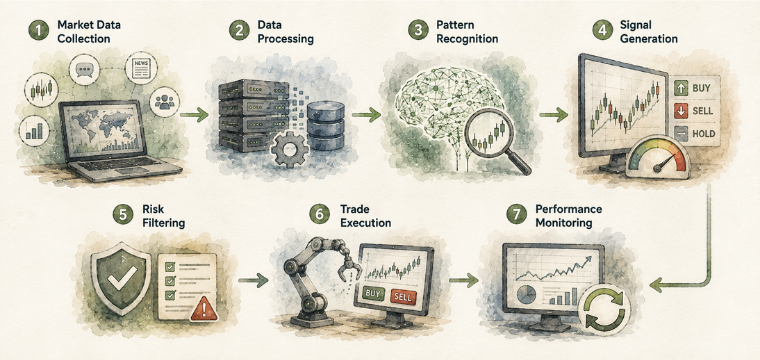
The typical flow looks like this:
- Market data collection: The system pulls in price data, volume, order book depth, news feeds, sentiment data and other relevant inputs.
- Data processing: Raw data is cleaned, normalized and prepared for model analysis.
- Pattern recognition: Machine learning models scan for recurring patterns, statistical anomalies or correlations across the dataset.
- Signal generation: The system outputs a signal: buy, sell, hold or exit, along with a confidence level or probability weighting.
- Risk filtering: Predefined rules filter out trades that exceed risk thresholds or do not meet quality criteria.
- Trade execution: If conditions are met, the trade is placed automatically or flagged for manual review, depending on how the system is configured.
- Performance monitoring: The system tracks results, and in adaptive models, feeds outcomes back into the training process.
How can traders benefit from AI?
Traders can immensely benefit from AI’s massive data processing power within a defined scope. AI trading systems can handle tasks that would take a human trader hours, or that simply cannot be done manually. What matters is knowing what the technology actually does rather than buying into the marketing around it.
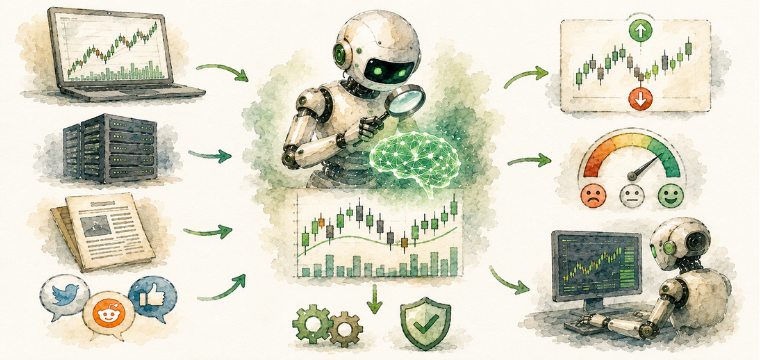
At its most useful, AI tackles the data problem:
- Scans huge amounts of data: Markets produce price moves, volume changes, order book activity, news, earnings calls and social media signals every second. No trader can keep up with all of it. AI can.
- Spots potential patterns: Machine learning models can scan hundreds of assets and timeframes for patterns that may be easy to miss manually.
- Generates trading signals: Based on that analysis, AI can flag possible entry or exit points, sometimes with a probability attached.
- Reads market sentiment: More advanced systems can process news and social media to gauge how traders feel about an asset. This can be particularly useful in crypto, where sentiment can shift prices quickly.
- Automates trades: Once the rules are set, AI can place trades, apply stop-losses and manage position sizes when the right conditions appear.
That speed can matter in fast-moving markets. A system can spot a signal and act on it without waiting for a trader to notice the setup first.
What AI cannot do is predict the future with certainty. Every signal is still a probability, not a promise. The trader remains responsible for understanding the risk and deciding how much uncertainty they are willing to accept.
AI trading vs Manual trading: What’s the advantage?
What are AI trading bots?
An AI trading bot is software that uses artificial intelligence or machine learning models to perform trading-related tasks automatically, including data analysis, signal generation and, in many cases, trade execution. Bots are how most beginners first encounter AI in a trading context, and understanding what they actually are matters before committing to one.
How an AI trading bot works
Most bots connect to a trading platform through an API (Application Programming Interface). The bot receives live market data, processes it through its model, and either executes trades directly or sends signals to the user for review. Some bots are fully autonomous and require no user input after initial setup. Others function as signal generators that present opportunities for the trader to act on manually.
The level of automation a beginner chooses should depend on their experience level, their risk tolerance and the regulatory environment of the platform they are using. Full automation without any manual oversight is generally not the right starting point for someone who is still learning.
AI trading bot vs traditional trading bot
A traditional trading bot follows fixed rules without exception: if the price crosses a defined level, execute the trade. It does not learn, adapt or improve based on new data. An AI trading bot uses machine learning models that can analyze patterns, incorporate new information and potentially refine their signals as market conditions evolve.
The distinction matters because many platforms market rule-based bots as AI tools. If the system cannot learn from new data or update its model in response to changing conditions, it is automation rather than artificial intelligence, and your expectations should reflect that.
AI trading vs algorithmic trading
How to use AI for trading as a beginner
Going straight into an automated system without knowing the basics can get expensive fast. AI tools may be easy to access, but that does not mean they are easy to use well.
- Learn the basics: Know what price, volume, support, resistance and market orders actually mean. Otherwise, it is hard to judge whether the AI is doing a good job.
- Pick a market: Decide whether you want to trade crypto, stock, forex or commodities CFDs. AI tools can work differently across markets.
- Set your rules first: Decide how much you are prepared to lose on one trade and what needs to happen before the system enters or exits a position.
- Backtest the strategy: Run it against historical data before risking real money. Remember that good backtest results don't guarantee the same results in live markets.
- Try demo trading: Use a demo or paper trading account and see how the system handles different market conditions before going live.
- Keep checking it: Automated does not mean set and forget. Review the results, watch for changes in market conditions and adjust the system when needed.
The same basic approach works whether you are using crypto AI tools or CFD trading platforms with AI-assisted analysis. The technology can handle much of the work, but the trader still needs to decide how much risk to take and when something no longer makes sense.
AI trading strategies beginners should know
AI can support all kinds of trading strategies. Knowing the main ones helps beginners understand what a system is actually doing, rather than getting caught up in claims about which strategy is supposedly “best.”
Here are the main approaches:
- Trend following: The system looks for an existing market trend and tries to trade in the same direction. AI can check several timeframes and more than just price, making it easier to filter out some market noise.
- Momentum trading: This focuses on assets that are already moving strongly. AI can look at additional signals to separate real momentum from a short-lived price move.
- Mean reversion: The idea is simple: when a price moves too far from its usual range, it may eventually move back towards its average. AI can spot these unusual moves and flag potential setups.
- Breakout trading: AI watches for prices breaking out of a defined range and looks for signs that the move could develop into a new trend rather than being a quick spike.
- Sentiment trading: AI can scan news, social media and online communities to gauge how people are feeling about an asset. This can be especially useful in crypto, where sentiment can change quickly.
Benefits and Risks of AI trading
Final Thoughts
AI trading is not the shortcut it is sometimes marketed as. The technology is genuinely useful: it can analyze data faster than any human, apply rules consistently, and monitor markets around the clock. But it works best as a tool in the hands of someone who already understands the basics, not as a replacement for that understanding.
The traders who use AI well tend to be the ones who treat it as one part of a larger process, not the whole answer.
If you are at the stage of exploring how to start investing across crypto and other markets, the practical next step is understanding what a platform actually offers before committing to anything.Change is an EU-regulated platform where you can invest in over 80 cryptocurrencies, or trade CFDs on stocks, forex, indices/ETFs and commodities, all from a single app. See how the platform works and whether it fits where you are in your investing journey.
CFDs are complex instruments and come with a high risk of losing money rapidly due to leverage. 56% of retail investor accounts lose money when trading CFDs with this provider. You should consider whether you understand how CFDs work and whether you can afford to take the high risk of losing your money.
FAQs
What is AI trading?
AI trading uses artificial intelligence to analyze market data, identify patterns, and generate or execute trading signals.
How can beginners use AI for stock trading?
Beginners can use AI tools to analyze stocks, identify trends, generate trading ideas, and automate parts of their trading process.
Is AI trading profitable?
AI trading can improve analysis and efficiency, but it cannot guarantee profits because markets remain unpredictable.
What are AI trading bots?
AI trading bots are software programs that use algorithms or AI models to analyze markets and automatically place trades based on set rules.
Is AI trading suitable for beginners?
Yes, beginners can use AI trading tools, but they should understand the risks and avoid relying on AI alone for trading decisions.