Ongoing volatility in traditional markets, driven by geopolitical tensions, inflation pressure, and shifting central bank policy, has made portfolio diversification more important than ever. As investors look for diversified investment options, index funds continue to gain popularity across Europe.
European ETF inflows have surged substantially over the past several years, highlighting the rapid shift toward passive investing and long-term wealth-building strategies.
For retail investors, index funds tend to become a core part of a balanced portfolio. They offer broad market exposure, lower costs, transparency, and reduced risk compared to picking individual stocks. Their simplicity also makes them an attractive option for beginners who want exposure to the stock market without actively managing investments.
Investors looking for exposure to major indices in Europe often consider products such as ETFs and index funds. However, some traders prefer index CFDs, which provide exposure to index price movements without owning the underlying asset. Understanding the difference is important before choosing an approach.
In this guide, we will explain how to trade and invest in European index funds and what to look for when selecting the right funds for your portfolio.
Key Overview
- Index funds in Europe are primarily accessed through ETFs or index CFDs, both of which are available with low minimum investments on modern EU-regulated platforms.
- Choosing an EU-licensed platform ensures your investments are protected under European financial regulation.
What Are Index Funds?
An index fund is an investment vehicle that tracks the performance of a specific market index, such as the S&P 500, EURO STOXX 50, or MSCI World. For example, if you select a EURO STOXX index, your investment will mirror the index's components.
The goal of investing in an index fund is to passively track the market without actively managing it. The benefits of the passive approach include lower management fees, diversification, lower risk, and the potential for steadier long-term returns.
When you invest in an index fund, your money is spread across all, or a representative sample of, the companies in that index. If the index rises, your investment grows proportionally. If it falls, it falls with it. There are no fund managers making active calls on index funds, which is a key reason why costs tend to be significantly lower than those of traditional actively managed mutual funds.
Why European Investors Are Turning to Index Funds
The appeal of index fund investing has strengthened considerably in recent years. With market volatility persisting and traditional savings accounts still offering weak real returns, many retail investors across Europe are seeking consistent, long-term strategies that don't require daily market monitoring.
Index funds often charge far lower fees, frequently under 0.2%, than actively managed alternatives, which charge between 1% and 2.5%. This makes a meaningful difference that compounds over a 10- or 20-year horizon.
A single index fund gives you simultaneous exposure to the top dozens or hundreds of companies across different sectors and geographies. Rather than betting on one company, you're effectively betting on the performance of an entire economy or market, which has historically been a more reliable approach for building long-term wealth.
The STOXX Europe 600 index has delivered strong long-term returns over recent years, while many actively managed funds have struggled to beat it consistently over longer periods.
CFD Index Trading is Rising
For years, index investing dominated the market; however, index trading has become increasingly popular among traders looking for flexible short-term exposure. For investors who want flexible exposure to major indices without committing to long-term fund positions, index CFDs offer a practical alternative to traditional ETFs.
CFDs, or Contracts for Difference, are derivative instruments that allow you to speculate on whether an index will rise or fall without owning the underlying asset. This means you can gain exposure to benchmarks like the EURO STOXX 500 and S&P 500 with a fraction of the capital a direct ETF position would require.
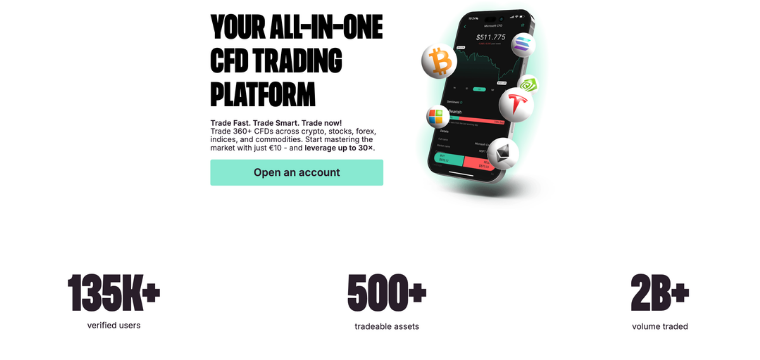
On platforms like Change, index CFDs sit alongside crypto and other asset classes in a single, streamlined app, helping users manage multiple markets in one place.
It is worth noting that CFDs are complex instruments and carry a higher level of risk than standard ETF investing, particularly when leverage is involved. They are regulated across the EU by ESMA and national authorities, and are generally better suited to investors who already have some familiarity with how markets move.
It's important to note that CFDs are complex instruments and carry significant risk, particularly when leverage is involved. They are regulated across the EU by ESMA and national authorities, and are generally better suited to investors with some prior experience.
That said, for investors who want short-term index exposure, the ability to act quickly on market movements, or simply the flexibility to diversify beyond long-term holdings, index CFDs on Change provide a straightforward and regulated way to do so.
Best European Index Funds For Trading
1. STOXX Europe 600 Index Funds
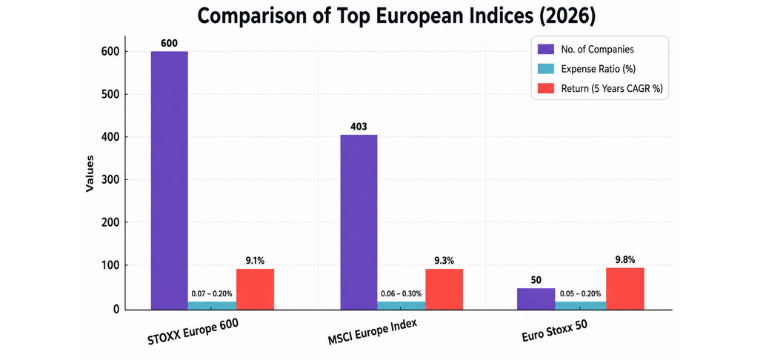
The STOXX Europe 600 index fund tracks 600 large-, mid-, and small-cap companies across 17 European countries and 11 sectors within Europe’s developed markets, providing broad and diversified exposure to the region. The aim of this fund is to provide diversified exposure to the region, mirroring the performance of the Stoxx 600 index.
Due to its popularity and wide market coverage, the index is often compared to the U.S.-focused S&P 500 index.
The expense ratio for STOXX Europe 600 index funds generally remains low, typically between 0.07% and 0.20% per year.
Top STOXX Europe 600 Index Funds
- Amundi Core Stoxx Europe 600 UCITS ETF Acc
- iShares STOXX Europe 600 UCITS ETF (DE)
- Xtrackers STOXX Europe 600 UCITS ETF 1C
Best for: Investors seeking diversification across market sizes and sectors in the European market.
2. Euro Stoxx 50 Index Funds
While broader European index funds track a wide group of large-, mid-, and small-cap securities, the Stoxx 50 index focuses on the top 50 largest and most liquid blue-chip companies in the euro area.
The fund takes a concentrated approach, so the weightings of stocks are higher. However, it should be noted that these stocks are blue-chip, meaning they have large market caps, so the growth prospects are lower, but stability is higher. The fund is similar to the Dow Jones Industrial Average (DJIA).
The expense ratio for Euro Stoxx 50 ETFs generally remains low, typically between 0.05% and 0.20% per year.
Top Euro Stoxx 50 ETFs
- iShares EURO STOXX 50 UCITS ETF (DE)
- Amundi Core EURO STOXX 50 UCITS ETF USD Acc
- Xtrackers EURO STOXX 50 UCITS ETF 1C
Best for: Investors seeking exceptional exposure to market leaders across the EU that have proven themselves and now rank at the top. However, concentration can increase drawdown during bearish market phases.
3. MSCI Europe Index
The MSCI Europe Index is a widely followed benchmark for developed European equities.. The fund captures large- and mid-cap representation across developed-market countries in Europe. The index covers a large share of the free-float-adjusted market capitalisation of the European equity markets.
The index is often used by institutional traders and international investors to measure the performance of developed European equity markets.
The expense ratio for MSCI Europe ETFs is usually competitive, though it can vary by provider and share class.
Top MSCI Europe ETFs
- iShares Core MSCI Europe UCITS ETF EUR (Acc)
- Xtrackers MSCI Europe UCITS ETF 1C
- iShares Core MSCI Europe UCITS ETF EUR (Dist)
Best for: MSCI Europe offers a middle ground between broader and more concentrated European index options. It can be a useful choice for long-term investors seeking diversified exposure to developed European markets. For long-term investors, this broader mix can help lower volatility while still providing strong exposure to European markets.
European investors can also invest in global index funds to gain exposure to offshore markets, and UK index funds traded on the London Stock Exchange offer country-specific index exposure.
How to Select Index Funds
Starting an investment has become much simpler with advances in technology; you can open an account and complete the process in just a few minutes. However, before that, you need to decide on your goals, investment capital, exposure, and risk tolerance.
Here is a clear, step-by-step path to making your first index fund investment in 2026.
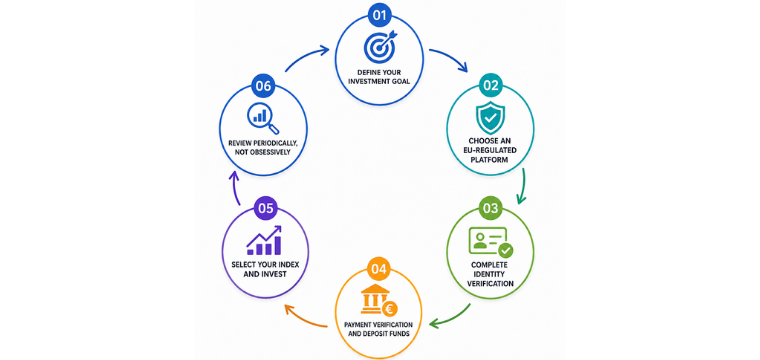
Step 1: Define your goal
One common mistake investors make is failing to define their investment objectives. You do not need a perfect roadmap, but having a basic plan helps. For example, someone investing for retirement over the next 20 years may choose an index fund ETF, while a trader looking for short-term market exposure may prefer an index CFD because it offers greater capital exposure
Step 2: Choose an EU-regulated platform
Always invest through a platform licensed and regulated within the European Union. This protects your capital and ensures your investment account operates within established legal frameworks. Advanced platforms like Change hold licenses under the EU’s Markets in Crypto-Assets (MiCA) regulation, creating a unified framework for crypto regulation across the European Union and offering a streamlined way to access multiple asset classes from one app.
Step 3: Complete identity verification
EU regulations require KYC (Know Your Customer) checks before you can invest. First, you have to provide a government-issued photo ID, such as a passport or national ID card. Then you need to provide proof of address, like a utility bill or bank statement, along with your Tax Identification Number (TIN) and country of tax residency.
Step 4: Payment verification and deposit funds
After completing verification, you need to verify your bank and source of funds; after that, you can deposit funds into your account. Many EU platforms support instant card deposits with no deposit fees. Minimum starting amounts can be as low as €10, making index investing genuinely accessible regardless of income.
Step 5: Select your index and invest
Choose your preferred benchmark, such as MSCI World, EURO STOXX 50, S&P 500 or another, and place your first investment. For a hands-off approach, look for platforms that offer automated recurring purchases, which allow you to invest a fixed amount on a regular schedule without needing to time the market.
Step 6: Review periodically, not obsessively
In the long term, index investing rewards patience. A quarterly portfolio review is usually sufficient. Reacting to short-term market fluctuations is one of the most common and costly mistakes new investors make.
Common Mistakes to Avoid
Even with a simple passive strategy, beginners frequently make avoidable errors that cost them in the long run. Being aware of these up front can save you significant time, money, and stress.
- Attempting to time the market: Waiting for the "perfect entry point" often means missing the strongest growth periods. Decades of data consistently show that time in the market outperforms market timing.
- Overlooking fees: Not all index products carry the same cost. Compare the Total Expense Ratio (TER) of ETFs and the spreads on CFDs before committing capital, because small percentage differences can compound materially over the years.
- Over-concentration in a single index: Investing heavily in a specific index can lead to high volatility during adverse market conditions and reduce diversification across sectors. You can supplement European indexes with global exposure via an MSCI World or MSCI Emerging Markets tracker.
- Panic selling during corrections: Market drawdowns are a normal part of investing, and selling during a downturn locks in losses rather than allowing the recovery that has historically followed.
Bottom Line
Index fund investing in 2026 rewards simplicity and consistency over complexity and market timing. Whether you're drawn to a globally diversified ETF, flexible index CFD exposure, or want to complement your portfolio with crypto, the strategy that works is the one you can stick to, started today, not when the market feels "right."
New-age platforms like Change bring all of this into one EU-regulated, mobile-first platform that combines access to crypto and CFDs across multiple markets with transparent pricing, instant deposits, and a simple user experience.
Frequently Asked Questions
How do beginners invest in index funds in Europe?
Beginners can open a brokerage account, choose a European index fund or an exchange-traded fund (ETF), and start investing with regular contributions.
What is the best European index fund for long-term investing?
Popular choices include MSCI Europe and STOXX Europe 600 index funds because of their broad market exposure.
Which exchange-traded funds offer broad diversification?
STOXX Europe 600 index funds offer broader market exposure.
Are index funds safe investments in Europe?
Index funds carry market investment risk, but they are generally considered lower risk than individual stocks because they are diversified.
What fees do European index funds charge?
Most index funds charge low annual fees, usually between 0.05% and 0.30%.
Which broker is best for buying index funds in Europe?
Change is a convenient option for users who want access to multiple markets in one app, with transparent fees and an easy onboarding process.