Gold’s nearly 250% gain since 2023, accelerated by strong bullish momentum during geopolitical tensions in the Middle East, has drawn significant attention to traditional investments like gold. Many investors are now asking whether gold is a good investment.
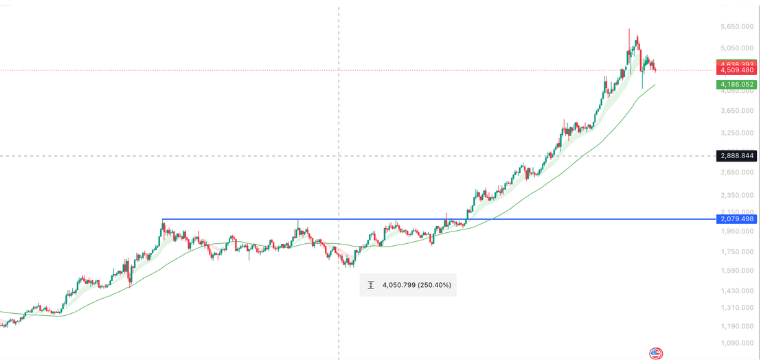
Gold rally 2023-26. Source: TradingView
The precious metal has been a store of wealth for thousands of years and is one of the oldest assets in the current global financial market. However, due to the devaluation of fiat and rising inflation over the years, gold has been hailed as a strong hedge. Over the last 20 years, gold has generated an impressive Compound Annual Growth Rate (CAGR) of 11.2% (global USD returns).
Gold has always held a special place in people's hearts, but does it still belong in a modern investment portfolio? This article breaks down the honest case for and against gold, and what that means for your investment strategy today.
This article is for informational purposes only and does not constitute investment advice. All investing involves risk, including the potential loss of capital.
Key Takeaways
- Gold is a proven store of value and a reliable hedge against inflation and currency risk, but it generates no income and can underperform significantly during prolonged bull markets.
- Gold works best as one component of a diversified portfolio, not as a standalone investment strategy.
Why Investors Turn to Gold
Gold’s appeal extends beyond price increases and bullish market cycles. For generations, it has served as a medium of exchange, a reserve asset, and, most importantly for retail investors, a hedge against instability.
For retail investors, unlike stocks, which let you own a part of a company on paper, gold is a tangible asset, a precious commodity. It has intrinsic value and a limited supply, which keeps demand intact and gives it a unique role in the global economy.
In European markets over the past generation, when currency devaluation, inflationary crises, and the collapse of savings occurred, gold represented the perfect hedge. An asset that couldn’t be printed away or debased by a government.
That human instinct of safety and trust hasn't faded in modern times. Today, when equity markets fall sharply, when central banks signal uncertainty, or when geopolitical tensions rise, gold tends to see increased demand. This pattern has repeated itself reliably enough that gold remains a core part of institutional and retail portfolios alike.
Historical Performance of Gold
Since 1970, gold has delivered an annualised return (CAGR) of approximately 8%, with its price per troy ounce peaking above $5,200 in January 2026 and trading around $4,400-$4,500 in May 2026.
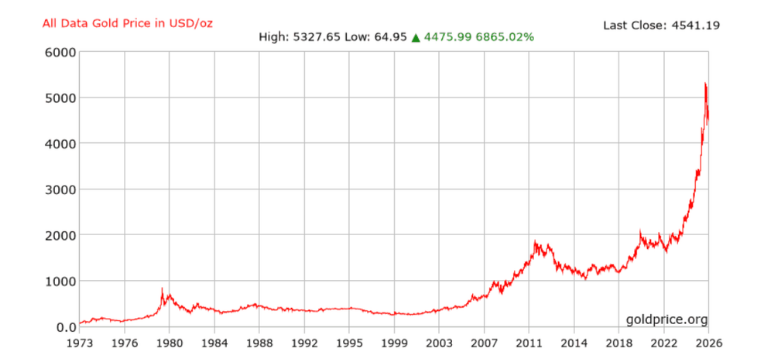
Historical gold price. Source: goldprice.com
However, the precious metal remained stagnant and failed to break its 2011 high for nearly a decade. In contrast, it has delivered returns of more than 200% in just the last three years.
According to data, the precious metal has returned an average of around 11.2% (in USD terms) over the past 20 years. For European investors holding euros, currency dynamics add another layer: when the euro weakens against the dollar, gold priced in EUR tends to rise even if its USD price holds steady.
Gold reached record highs above $5,200 per ounce in January 2026, driven by central bank buying, geopolitical uncertainty, and strong investor demand for safe-haven assets. This strong run has brought renewed attention to gold across EU retail markets, but it also raises the question of whether investors are arriving late to the party.
Pros and Cons of Investing in Gold
Gold offers several genuine advantages, particularly for investors who prioritise capital preservation alongside growth, but it also has limitations for those seeking faster growth. Understanding both the pros and cons of investing in Gold will help you make a clearer, stronger investment decision. All investing involves risk, including the potential loss of capital.
Real Pros of Investing in Gold
1. Safe-haven asset
One of gold's most consistent characteristics is its role as a safe-haven asset in times of crisis. During the COVID-19 market crash of March 2020, gold initially dipped but recovered sharply within weeks. The market then saw gold prices rise and reach record highs, while many equity indices took 12 to 18 months to fully recover their losses.
For investors, this safe-haven function also provides a degree of insulation from local currency risk and regional economic exposure. Holding some gold provides a buffer genuinely uncorrelated with domestic economic performance. However, it is a safer bet, not a risk-free investment.
2. Inflation hedge
When the purchasing power of money falls as households experience acute inflation between 2021 and 2023, with eurozone inflation peaked at 10.6% in October 2022, gold has historically held or increased its real value. Gold has long been called a hedge against inflation, and this characteristic makes it especially valuable during sustained inflationary periods.
3. Diversification
Gold typically has a low or even negative correlation with equities, meaning it often moves in the opposite direction to stock markets. This cushioning effect can meaningfully reduce the overall volatility of a mixed portfolio without necessarily sacrificing long-term returns. Gold may be a low-risk, low-reward asset, but it provides immense stability to the portfolio.
4. Liquidity
Unlike real estate or certain fixed-income products, gold can be bought and sold quickly across global markets, 24 hours a day, without significant liquidity risk.
However, after buying physical gold, such as gold coins or gold bullion, it can take more time and effort to sell than many other investments. If gold market prices fall and you need money quickly, you may have to sell at a lower price. Buyers and dealers may also charge extra fees or premiums, which can reduce your overall returns.
Limitations of Gold as an Investment
1. Not income-producing
Stocks pay dividends, and bonds provide interest income; however, gold produces no income. Gold can only be held for long-term investment purposes, as its entire return depends on price appreciation, which can be slow, flat, or negative over short- to medium-term periods.
2. Long-term investment asset
Between 2011 and 2015, gold fell from a high of around $1,900 per ounce to below $1,050, and largely stagnated until 2018. This could have been a period where investors were forced to sell at a loss. Timing the market and holding for a significant period are crucial in gold investing or sizing up or down gold holdings.
3. Stock Market outperformance
Gold prices have climbed sharply in recent years, but the stock market has still delivered stronger long-term returns. Investors who allocate most of their money to gold may miss out on the higher growth potential that stocks can offer over time. While gold can help protect wealth during uncertainty, relying too heavily on it could limit overall portfolio growth.
Over long bull market cycles, gold tends to lag significantly behind equities. During the 2010s, a globally diversified equity index fund would have outperformed gold substantially for investors who remained invested.
4. Custody problems
For those owning physical gold, such as gold sovereigns, gold coins or gold bars, storage and insurance costs add further drag on returns. Gold ETFs and funds solve the custody problem but incur annual management fees and still offer no yield.
How Investors Can Access Gold Investments

There are several practical routes to gold exposure for retail investors, each with distinct trade-offs:
- Physical Gold: This is direct ownership in the most straightforward form: gold coins or bars purchased from a government mint or an accredited dealer. You actually own the asset, so no counterparty risk and zero dependencies on any platform.
However, because physical gold needs to be insured and kept in safe custody at home or with a vaulting professional service, you would have to pay a higher premium upfront.
- Gold ETFs: The custody problem is entirely solved by using exchange-traded funds (ETFs) that track the spot price. With each share in an ETF or gold mutual fund backed by physically held gold, you never have to worry about where your gold is stored.
ETFs are traded via stock exchanges like any regular share, which means they're 100% liquid during market hours, and management fees are annual (0.15–0.40% on average). Gold ETF exposure can be easily bought by any investor who already holds a brokerage account.
- Gold Mining stocks: This method provides investors with indirect access to gold through shares of firms engaged in core gold mining or related activities. These stocks can outperform the metal itself in bull markets.
Conversely, they have their own company-specific risk factors, such as management quality, mine location geopolitics, energy price levels, gold miners, associated costs, stock market stress and hedging policies. This is a much more complicated and higher-risk path than directly owning gold, because even if the price of gold rises, a mining company can underperform due to operational issues or rising costs.
- Commodity CFDs: CFDs (contracts for difference) enable investors to participate in gold price movements without buying any physical gold or shares. A CFD simply follows the price of gold; if the price moves up, you profit, down, you lose, but you do not own any gold.
CFDs require much lower initial capital than physical gold, can be traded in larger positions, whether long or short, and are accessible through mobile or desktop devices.
For investors using Change’s commodities trading platform, commodity CFDs provide a fast, low-barrier entry point. You can gain exposure to gold price movements from as little as €10, without storage costs, without a brokerage setup, and without needing to navigate a complex interface.
Gold vs. Other Asset Classes

When assessing gold, it helps to compare it directly with other common investment options considered by retail investors.
Since its massive growth after 2017, Bitcoin is frequently positioned as "digital gold", sharing some of gold's scarcity logic while offering far greater volatility and growth potential. Bitcoin is increasingly held alongside gold by investors who want both stability and upside.
Many modern investors are choosing to hold both assets, using gold for capital preservation and crypto for long-term growth, rather than treating them as mutually exclusive.
Bottom Line: Building a Portfolio That Includes Gold
Gold is effective when it has a specific, proportional role in a larger strategy. Many financial advisors and investment frameworks recommend allocating 5–10% of a retail investor's portfolio to gold.
Younger investors with years ahead of them normally favour growth: equities and perhaps crypto take a bigger slice, then gold plays a bit more of a stabilising role than anything else. But whether you're nearing your financial goals or heading toward capital preservation, mitigating volatility with a higher gold weighting can measurably improve your portfolio.
The multi-asset approach is something most investors can only dream about, but it will become genuinely accessible with platforms like Change, which combines an easy app experience to access exposure to this innovation with crypto, commodity CFDs, including gold and even global market instruments all in one place, no account minimum and no hidden fees!
The right allocation for any individual depends on personal financial circumstances, risk tolerance, and investment goals. Only you can assess what’s right for you. All investing involves risk, including the potential loss of capital.
Frequently Asked Questions (FAQs)
1. What is the average return on gold over 10 years?
Gold has delivered an average annual return of approximately 13.3% over the past decade.
2. Is gold better than stocks as a long-term investment?
No, equities outperform gold over most long-term periods, particularly when dividends are included. Gold's role is capital preservation and diversification, not aggressive growth.
3. How much of my portfolio should I put in gold?
Most investment frameworks recommend allocating 5–15% of a portfolio to gold, depending on risk tolerance and timeline. Only you can assess what’s right for you.
4. Is buying physical gold a good idea?
Yes, physical gold is a reliable store of value and could provide stable returns over a long period of time. Only you can assess what’s right for you.
5. Can I invest in gold with a small amount of money?
Yes, through commodity CFDs and ETFs, you can access gold exposure from as little as €10, with no storage costs or complex setup required.