Robotics is no longer a niche story that is shown in films as science fiction or research labs. After the AI boom, robotics could be the next target of investors.
From mega factories deploying thousands of robots to simple in-house cleaning, automated systems are changing how the world works.
However, it is not that easy to find which companies are leading this change in robot manufacturing, designing, and deployment. To trade CFDs on robotic stocks, investors must know what the companies actually do and why the sector draws so much attention.
In this article, we have discussed top robotics stocks to watch that either generate direct revenue from robotic products or have committed significant capital to robotics operations.
Key Takeaways
- Robotics stocks are shares of companies that build, sell, or integrate robotic systems across manufacturing, healthcare, logistics, and artificial intelligence.
- Understanding each company's market exposure, growth catalysts, and risk factors is essential for anyone following the robotics sector closely.
What are robotics stocks?
Robotics stocks are shares of publicly traded companies involved in developing, manufacturing, or deploying robotic systems and automation technologies.
This category includes industrial robot makers, surgical robotics firms, AI-powered automation platforms, machine vision specialists, and companies building the computing infrastructure that modern robots rely on.
Not all robotics stocks are necessarily pure-play robotics businesses. Some take revenue from their robotics efforts as a slice of a larger technology-or industrial company. Others collect the bulk of their revenue from direct robotic goods, services, and continuing instrument revenues.
But why robotics stocks could be the next thematic rotation in the stock market:
- AI is moving from software to hardware: Nvidia's CEO Jensen Huang highlighted “physical AI” as the next wave of AI during his CES 2025 keynote. Global robotics market revenue is projected to reach $218 billion by 2030, up from around $78 billion in 2024.
- Labor economics are forcing corporate hands: US manufacturing job openings have consistently exceeded available workers since 2021. With wages rising and reshoring accelerating post-tariff, companies face a structural pressure to automate, creating durable, policy-backed demand that is harder to reverse than a sentiment trade.
- Institutional interest is growing: ARK Invest's Autonomous Technology & Robotics ETF (ARKQ) saw renewed institutional interest and volume growth following the AI physical integration shift. Meanwhile, Goldman Sachs estimates humanoid robots alone could become a $6 billion market by 2030, with early-stage capex already appearing in Tesla, Nvidia, and Amazon earnings calls.
Robotics stocks also carry the volatility and uncertainty typical of an early-stage, hype-sensitive sector, and individual company outcomes will vary widely.
Best robotics stocks to watch now
Here is a quick comparison before diving into each:
NVIDIA Corporation (NVDA)
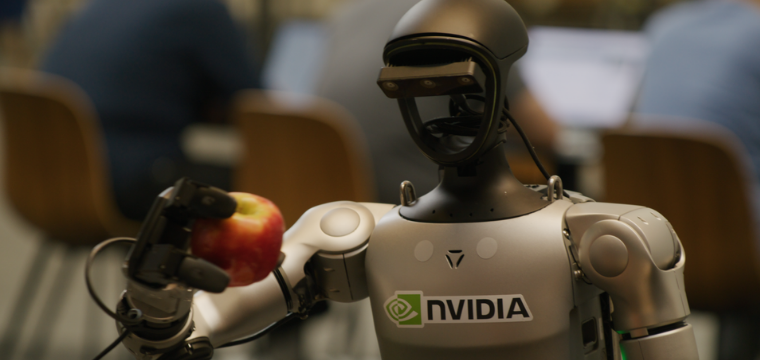
NVIDIA is a US-based semiconductor company best known for its graphics processing units. In recent years, it has built a substantial robotics infrastructure business through its Isaac platform, which provides AI computing tools for robot development, simulation, and deployment.
Its Jetson edge AI modules power robotic systems used in hundreds of commercial and industrial applications.
Why investors watch it
NVIDIA's GPUs are the computational backbone of many modern robotic systems. Its Isaac GR00T foundation model for humanoid robots has attracted significant attention from robot manufacturers and developers. NVIDIA has also announced partnerships with companies including Boston Dynamics and 1X Technologies, positioning it as infrastructure for the next generation of physical AI systems.
Robotics exposure
- Isaac Sim and Isaac GR00T platform for humanoid and industrial robot development
- Jetson computing modules used in autonomous machines and logistics robots
- AI training infrastructure used by robotics developers worldwide
- Growing involvement in humanoid robot simulation and training pipelines
Key growth drivers
- Expanding demand for AI-powered robotics in warehouses and manufacturing facilities
- Humanoid robot development requiring high-performance simulation and computing
- Industrial digitization creating demand for edge AI hardware
- Continued GPU demand from robotics software developers and manufacturers
Potential risks
NVIDIA trades at an elevated valuation relative to most industrial peers, reflecting high growth expectations. Any slowdown in AI infrastructure spending, increased competition in AI chips, or delays in commercial humanoid deployment could affect sentiment around the stock.
Cognex Corporation (CGNX)
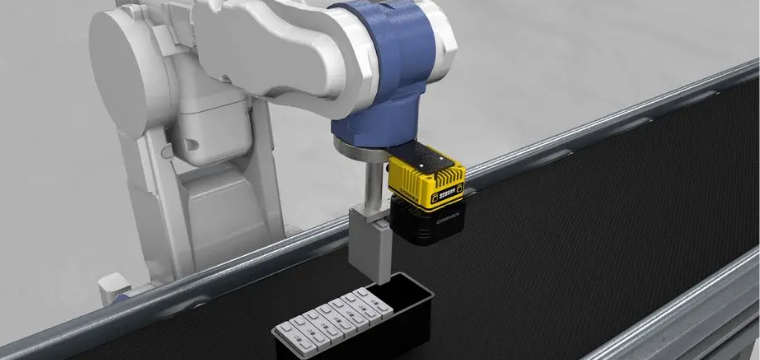
Cognex Corporation is an American technology company and the world's leading dedicated provider of machine vision systems, sensors, and software. Machine vision gives automated machines the ability to see and make decisions based on what they observe, enabling quality inspection, barcode reading, and precision guidance in manufacturing and logistics environments.
The company serves more than 30,000 customers across automotive, electronics, semiconductor, consumer goods, and logistics industries worldwide.
Why investors watch it
Cognex holds a dominant position in industrial machine vision, a technology that underpins how modern robots and automated systems perceive and interact with their environment. In 2024, the company reported full-year revenue of $937.2 million, a 9% year-over-year increase.
Its AI-powered OneVision platform, which combines cloud-based model training with edge deployment, is expanding into applications where traditional rule-based vision previously could not operate reliably. Q3 2025 revenue grew 18% year over year, with EBITDA margins reaching 24.9%.
Robotics exposure
- Vision systems enabling quality inspection and defect detection in automated production lines
- Barcode reading and traceability solutions powering logistics and warehouse robotics
- AI-enabled vision through the OneVision platform for flexible and unstructured manufacturing
- Semiconductor wafer and component inspection systems used in chip fabrication
- Vision guidance systems for robotic pick-and-place and precision assembly operations
Key growth drivers
- AI integration extending machine vision into new applications and customer segments
- Semiconductor capital expenditure supporting sustained inspection system demand
- E-commerce logistics growth driving barcode reading and automated sortation deployment
- Over $139 million in annual R&D investment maintaining product and technology leadership
- Medical lab automation and pharmaceutical manufacturing as emerging growth verticals
Potential risks
Cognex is exposed to cyclical swings in semiconductor and automotive capital expenditure, which can compress demand significantly in downturns. The company also faces a shifting competitive environment as AI-native computer vision software and embedded vision systems reduce the need for dedicated machine vision hardware in some applications.
Intuitive Surgical (ISRG)
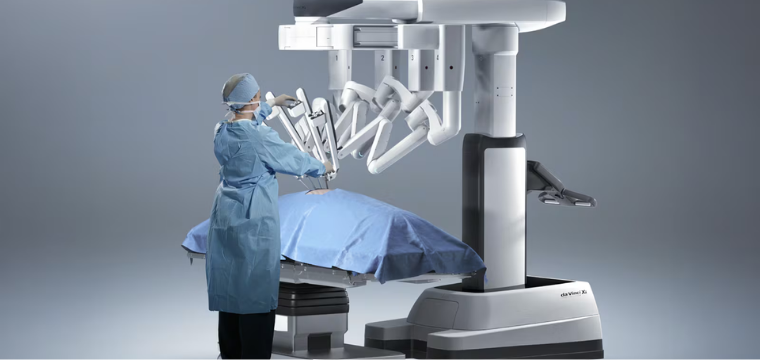
Intuitive Surgical is the dominant company in robotic-assisted surgery, known primarily for its da Vinci surgical system. The system enables surgeons to perform minimally invasive procedures with greater precision using robotic instruments controlled from an ergonomic console. It is one of the clearest examples of a company whose revenues are almost entirely driven by robotic products and services.
Why investors watch it
Intuitive Surgical has a particularly defensible market position in medical robotics. Its installed base of over 9,000 da Vinci systems globally generates recurring revenue through instruments, accessories, and service contracts. In full-year 2024, the company reported revenues of approximately $8.13 billion, with procedure volumes continuing to grow year over year. The introduction of the da Vinci 5 system in 2024 added further momentum.
Robotics exposure
- da Vinci surgical system for minimally invasive general, urological, and gynecological surgery
- Ion endoluminal system for minimally invasive lung biopsy procedures
- Recurring per-procedure revenue from instruments and accessories
- Service and maintenance contracts across the global installed base
Key growth drivers
- Expansion of robotic surgery into new procedure categories
- Growing international installed base outside the United States
- Rising demand for minimally invasive surgery in aging populations across Europe and Asia
- Continued adoption of the next-generation da Vinci 5 platform
Potential risks
Competition is intensifying. Medtronic's Hugo robotic system and Johnson and Johnson's Ottava platform are both advancing through clinical development and regulatory processes. Regulatory approval timelines in new markets can also delay international expansion.
Teradyne (TER)
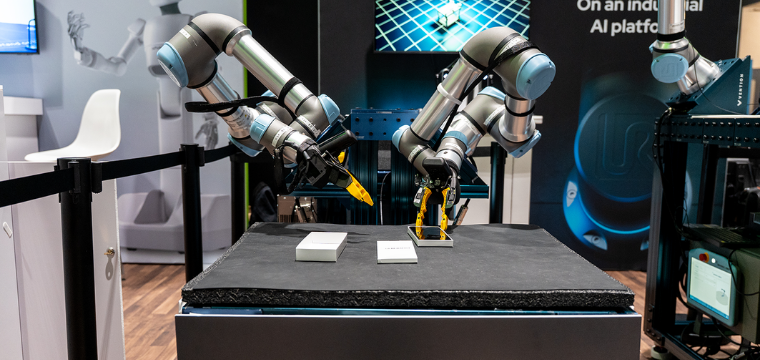
Teradyne is a US-based automated test equipment company that also owns Universal Robots, one of the world's leading manufacturers of collaborative robots. Universal Robots designs lightweight robot arms built to work alongside human workers, commonly known as cobots. The company also owns Mobile Industrial Robots, which produces autonomous mobile robots used for indoor material transport.
Why investors watch it
Universal Robots, acquired by Teradyne in 2015, has become one of the most widely deployed cobot brands globally. Collaborative robots are growing quickly because they require less infrastructure than traditional industrial robots, can be redeployed across tasks, and suit the budgets of small and medium-sized manufacturers. Teradyne's automated test equipment also serves semiconductor and electronics manufacturers directly, giving it two distinct robotics-adjacent revenue streams.
Robotics exposure
- Universal Robots cobots for assembly, packaging, and quality inspection applications
- Mobile Industrial Robots autonomous vehicles for internal logistics and material transport
- Semiconductor test equipment with robotics integration
- Growing third-party application ecosystem for the Universal Robots platform
Key growth drivers
- Cobot adoption among small and medium enterprises replacing or supplementing manual labor
- Expanding application library and ecosystem around Universal Robots hardware
- Mobile robot demand in warehousing, healthcare facilities, and manufacturing logistics
- Semiconductor capital expenditure cycles driving automated test equipment demand
Potential risks
Teradyne's revenue is partly tied to semiconductor capital expenditure cycles, which are inherently cyclical and can shift quickly. Competition in the cobot market is increasing, with ABB, Fanuc, Doosan Robotics, and newer entrants all competing for share. Pricing pressure at Universal Robots is a developing consideration as the market matures.
Ouster, Inc. (OUST)
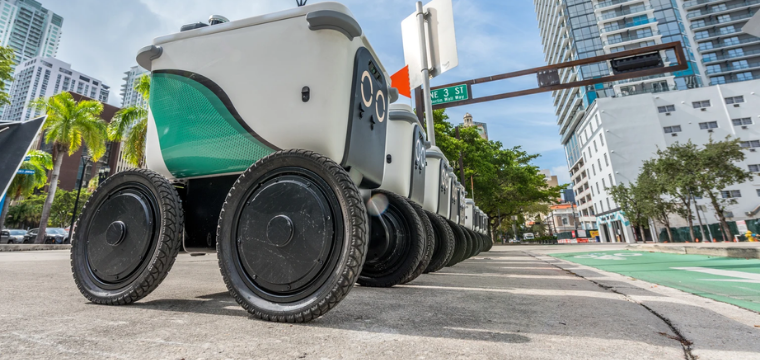
Ouster is an American lidar sensor and software company operating at the intersection of robotics, industrial automation, and autonomous systems. Its high-resolution digital lidar sensors give machines three-dimensional spatial awareness, a fundamental capability for autonomous robots, mobile platforms, and smart infrastructure systems.
In 2023, Ouster completed a merger with Velodyne Lidar, combining intellectual property portfolios spanning over 170 granted patents and expanding its customer base across robotics, industrial, automotive, and smart infrastructure verticals. Stock and financial data for Ouster is available via its listing on Nasdaq.
Why investors watch it
Ouster has delivered thirteen consecutive quarters of product revenue growth. Full-year 2024 revenue reached $111 million, a 33% increase over 2023, with GAAP gross margins improving from 10% in 2023 to 36% in 2024. Quarterly revenues continued expanding through 2025, reaching $39.5 million in Q3 2025, a 41% year-over-year increase. The company describes its positioning as a Physical AI sensing platform, providing the spatial intelligence layer that intelligent machines need to operate in real-world environments.
Robotics exposure
- Digital lidar sensors providing 3D spatial perception for autonomous robots and mobile platforms
- Ouster Gemini perception software for industrial automation and safety zone monitoring
- BlueCity smart infrastructure platform for traffic analysis and pedestrian safety management
- Physical AI sensing and perception stack expanded by the 2024 acquisition of Stereolabs
- Sensors deployed across logistics robotics, industrial automation, automotive, and smart cities
Key growth drivers
- Growing lidar adoption in warehouse mobile robots and autonomous guided vehicles
- Smart infrastructure deployments for safety monitoring, traffic management, and urban analytics
- Stereolabs acquisition adding camera and AI compute capabilities alongside lidar
- Record shipments of over 25,000 sensors in 2025, with 13 consecutive quarters of product revenue growth
- IP licensing and software-attached revenue improving the company's gross margin profile
Potential risks
Ouster is not yet profitable, carrying an accumulated deficit of over $400 million, with profitability not expected before 2028 under current projections. Customer concentration is a meaningful risk, with two customers each accounting for more than 10% of 2025 revenue.
The lidar market remains competitive, with rivals including Luminar Technologies and Hesai Group competing across overlapping industrial and automotive segments.
Tesla, Inc. (TSLA)
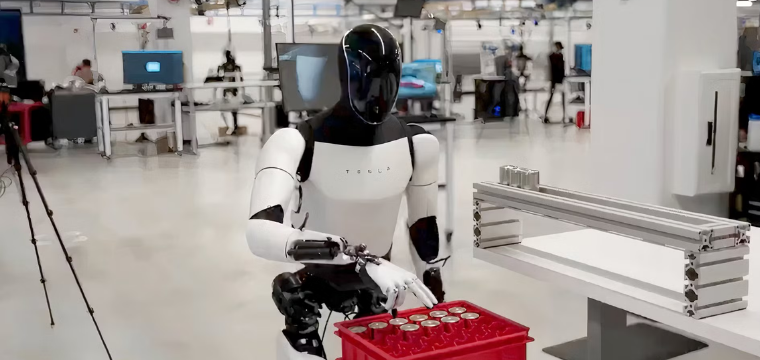
Established in July 2003, Tesla is an American electric vehicle and clean energy company and has quickly emerged as one of the most-watched names in humanoid robotics. Tesla has started work on the Optimus program, which aims to create a more general-purpose humanoid robot designed for tasks at its own factories, with the possibility of being made available commercially to other companies.
Tesla integrates its in-house AI vision and compute capability (originally designed for autonomous vehicles) but with robotic mechanical hardware that can complete physical tasks.
Why investors watch it
Tesla is one of the few companies deploying humanoid robots in an operational manufacturing environment rather than a controlled research setting. The company reported internal Optimus deployment across its Gigafactories during 2024, with stated ambitions to scale that deployment significantly through 2025.
Tesla's substantial AI infrastructure, including its Dojo supercomputer and custom silicon chips, gives it a technology foundation that most new humanoid robot developers do not yet possess.
Robotics exposure
- Optimus humanoid robot program targeting internal factory deployment and eventual commercial sale
- Active use of Optimus robots within Tesla Gigafactories for manufacturing tasks
- AI and computer vision systems adapted from its autonomous vehicle technology stack
- Dojo supercomputer providing AI training infrastructure for robotic learning
- Full Self-Driving neural network capabilities being integrated into robotic control systems
Key growth drivers
- Internal factory deployment of Optimus robots reducing dependence on manual labor at scale
- Potential future commercial sales of Optimus robots to external manufacturers and operators
- AI training data generated across its vehicle fleet applicable to robotic movement and decision-making
- Existing manufacturing scale and supply chain infrastructure suited to hardware production at volume
- Rising industry and investor interest in general-purpose humanoid robots across commercial applications
Potential risks
Tesla's robotics business remains in a developmental phase, with limited external revenue from robotic systems as of the time of writing. Execution risk is significant. Delivering a general-purpose humanoid robot at commercial scale involves considerable engineering, cost, and timeline uncertainty.
Tesla also faces intensifying competition in humanoid robotics from well-funded startups including Figure AI, Apptronik, and Agility Robotics, as well as established industrial automation companies expanding into the space.
Conclusion
Robotics companies operate across many sectors, including manufacturing, healthcare, logistics, semiconductors, and artificial intelligence. Each of the companies covered here brings distinct technology, market exposure, and risk considerations that make them relevant to anyone tracking how automation is reshaping the global economy.
Now, those of you who have a clearer picture of the robotics sector and want to understand how to get exposure to global equity markets, including technology and automation stocks, can explore Change to see what markets are available, how the platform works, and what it costs to get started.
CFDs are complex instruments and come with a high risk of losing money rapidly due to leverage. 60% of retail investor accounts lose money when trading CFDs with this provider. You should consider whether you understand how CFDs work and whether you can afford to take the high risk of losing your money.
FAQs
What are the best robotics stocks to watch in 2026?
Some robotics stocks to watch in 2026 include Nvidia, Tesla, Intuitive Surgical, and Teradyne.
Why are robotics stocks gaining attention in 2026?
Robotics stocks are gaining attention as automation, artificial intelligence, and industrial robotics expand across industries.
Which industries are driving robotics growth?
Manufacturing, healthcare, logistics, automotive, defense, and warehousing are among the key industries driving adoption of the robotics sector.
What should investors look for in robotics stocks?
Key factors include robotics industry exposure, revenue growth, profitability, innovation, competitive position, and automation demand.
Are robotics stocks a good long-term investment?
Robotics stocks may offer long-term growth potential, but performance depends on each company's fundamentals, valuation, overall growth of the robotics sector, and market conditions.