When beginners start trading, they think they are smarter than the financial markets and repeat some common trading mistakes. Losses in trading are not a rarity because you’re definitely going to lose some trades and win some trades, but repeating common mistakes leads to consecutive losses that could potentially blow your account.
If you’re just starting out, here we have discussed some of the biggest mistakes beginners make that you can avoid. This guide will build awareness of these errors and shorten the learning curve.
Key Takeaways
- Trading mistakes are errors in judgment, planning, or discipline that negatively affect results over time.
- One of the biggest trading mistakes beginner traders make is not having a backtested and their own trading plan.
What are trading mistakes?
Trading mistakes are errors in planning, risk management, execution, or psychology that consistently damage a trader's results over time. Unlike a single bad outcome caused by unpredictable market conditions, these patterns tend to repeat until you identify and address them.
Beginners think that less trading knowledge is the cause of their failure; however, after going through the cycle, an experienced trader knows that not repeating common mistakes is what separates disciplined trading from reactive trading.
Trading mistakes can occur at any stage, before entering a trade, while managing it, or during the review process afterward. Some are technical, such as ignoring stop-losses or misunderstanding leverage. Others are psychological, such as chasing losses or abandoning trading strategies too quickly.
However, understanding and correcting these mistakes with discipline in CFD trading across crypto, commodities, or any other asset class can significantly affect your learning curve and overall trading results.
7 Most Common Trading Mistakes
The seven mistakes below appear consistently across traders of all experience levels. Each covers what the mistake is, why it happens, and how to reduce its impact.
Mistake #1: Trading without a plan
Markets move in cycles at both business and technical levels, and that is where traders find an edge. Without a proven process with positive expectancy, failure is almost guaranteed.
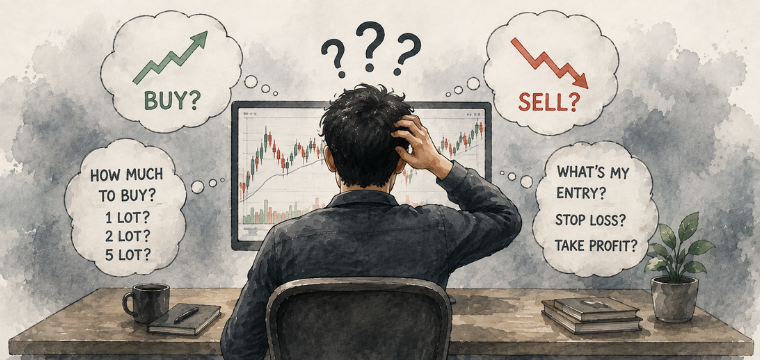
A trading process is defined by entry, order type and exit rules, risk limits, and clear objectives like trading higher timeframes in swing or positional or day trading, without it, every trade becomes a reaction rather than a decision. This is the most foundational mistake a trader can make, and one of the hardest to correct once poor habits form.
However, that doesn’t mean a trading plan has to be complex. It should define the conditions that trigger an entry, how much capital is at risk, and exactly when the trade will close, whether it moves in the trader's favor or against them. The goal is to remove as many in-the-moment decisions as possible, because that is when emotional influence is strongest.
Mistake #2: Risking too much on a single trade
Risk management is one of the most crucial pillars of trading. It differentiates a successful trader from a consistently losing one. This is why position sizing based on the specific risk reward ratio of the trade in hand is crucial. Committing too large a portion of capital to one trade means a losing trade can cause significant damage that is genuinely difficult to recover from.
Not using a stop-loss is also a major mistake beginner traders make, and it completely undermines risk management. This way, your risk becomes the amount you have put in, and a few of these trades could easily blow your account.
A widely referenced approach is to risk only a small, consistent percentage of total capital per trade, often cited at around 1–2%. This lets traders absorb a run of losing trades without disrupting their ability to keep trading. The exact percentage matters less than applying it consistently. Managing risk well isn't about avoiding losses altogether, it's what allows traders to stay in the game long enough to capture the upside when their plan works.
Mistake #3: Using excessive leverage
One belief that leads to blown accounts is that trading is a quick way to get rich, which is why beginner traders use excessive leverage and take massive losses. Leverage amplifies both gains and losses. Without a clear understanding of the risk, it can turn a modest unfavorable move into a much larger-than-expected loss.
Leverage increases market exposure, not the probability of a successful trade. Learning how CFD trading and leverage work before applying them is straightforward preparation that significantly reduces this risk.
Mistake #4: Overtrading
Overtrading occurs when a trader takes more positions than their strategy supports. It is typically driven by boredom, impatience, or the urge to recover recent losses as quickly as possible.
More trades do not automatically create more opportunity. Each position adds spread and fee costs, plus exposure. A high volume of trades placed without clear rationale tends to raise costs and risk without a corresponding improvement in outcomes. A defined set of entry criteria, followed consistently, is the most practical check against this pattern.
Mistake #5: Revenge trading after a loss
One of the biggest emotion-driven mistakes is revenge trading. You take a loss, it stings, and you go into revenge mode, setting your process and rules aside."This usually happens when a trader re-enters the market immediately after a loss, intending to recover that money quickly. The decision is driven entirely by emotion rather than analysis.
This mistake is particularly damaging because the trader's mindset in that moment is rarely objective. Losses can intensify focus on the outcome rather than the process, leading to poor entries and an escalating cycle of increasing risk. The most effective response to a loss is usually to step back, review what happened against the original plan, and wait for the next planned setup.
Mistake #6: Letting emotions control decisions
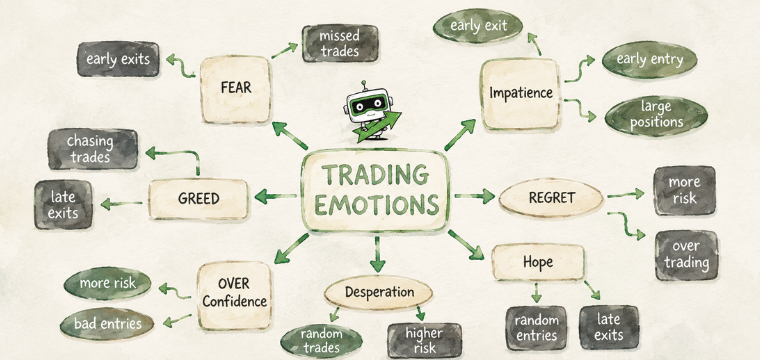
Fear and greed are the two emotional forces that most often affect trading decisions. Fear can cause a trader to exit a position too early or avoid entering at all. Greed can lead to holding past an intended target or taking on more risk than the plan allows.
Emotional responses tend to override the logical framework a trader has already built. The solution is not to eliminate emotion; that is not realistic, but to reduce the decisions that are made in the presence of it. Reviewing a structured plan before entering any trade, and sticking to predefined exit conditions, removes much of the space where emotion typically takes over.
Mistake #7: Failing to keep a trading journal
It is said that the best trading book you can read is your trading journal because it contains all your mistakes, weaknesses, and strong points that can massively help you improve your trading. A trading journal records entries, exits, the reasoning behind each trade, and the result. Without it, identifying recurring behavioral patterns or pinpointing exactly where a strategy is breaking down is very difficult.
Traders who review their journals regularly tend to correct mistakes faster than those who rely on memory alone. Even a basic log creates useful data over time. It shifts performance review from a vague impression of how things are going to an objective record of what is actually happening.
Trading mistakes at a glance
Why do traders keep making the same mistakes?
Knowing the cause of the disease is as important as treating it. That's why understanding why trading mistakes recur is as important as knowing what they are.
A significant reason is psychology. The human brain is not naturally suited to the trading environment. It tends to seek patterns where none exist, over-weight recent events, and prioritize avoiding regret over making objectively better decisions. These tendencies appear consistently across people regardless of experience or intelligence.
Habits also play a role. Traders who do not review their performance regularly have no way to identify what is not working. Without that feedback loop, the same errors repeat across different trades and market conditions without being recognized. According to research into trading behaviour and decision-making, a lack of structured self-review is one of the most consistent factors in persistent underperformance among retail traders.
Finally, emotional regulation is genuinely difficult in a live trading environment. Knowing what not to do and applying that knowledge under the pressure of an open position are two different things. Developing that skill takes time, structured review, and honest self-assessment.
How can traders avoid common trading mistakes?
Eliminating trading mistakes entirely is unrealistic. Reducing their frequency and their impact, however, is achievable with consistent habits and a clear framework:
- Define risk before entering any trade: Knowing the maximum acceptable loss on a position before placing it creates a boundary that reduces emotional pressure during the trade itself.
- Create a trading plan and follow it: A plan that defines entry conditions, exit targets, and risk limits removes the need to make those decisions in the moment, when emotions tend to run highest.
- Use consistent position sizing: Applying a fixed percentage risk per trade, rather than varying it based on confidence level, removes a frequent source of disproportionate losses.
- Keep a trading journal: Recording every trade, including the reasoning and the result, builds a dataset that makes it possible to identify patterns over time and correct them with evidence rather than instinct.
- Review performance regularly: Weekly or monthly reviews help you see whether a strategy is producing results and whether a specific mistake keeps recurring across multiple trades.
- Understand leverage and costs before trading: Knowing how leverage affects total exposure and what fees apply on a given platform removes two common sources of unexpected losses that catch many traders by surprise.
- Start with smaller positions: Reducing position size while you develop your skills limits the financial impact of early mistakes without eliminating the learning process.
Final Thoughts
Trading is a never-ending learning game, even if you are successful, you must continually adapt to new market conditions and overcome your errors. Avoiding trading mistakes is not about achieving perfection on every trade. It is about building habits that reduce the frequency and impact of errors over time, and developing a review process that enables continuous improvement.
Now that you have a clear understanding of common trading mistakes and want to improve your trading process and execution, you can explore the Change trading platform to use the advanced trading tools available, learn how the platform works, and see what it costs to get started.
CFDs are complex instruments and come with a high risk of losing money rapidly due to leverage. 56% of retail investor accounts lose money when trading CFDs with this provider. You should consider whether you understand how CFDs work and whether you can afford to take the high risk of losing your money.
FAQs
What are the most common trading mistakes?
Common trading mistakes include poor planning, excessive risk, high leverage, overtrading, revenge trading, emotional decisions, and failing to keep a journal.
How can traders avoid common trading mistakes?
Traders can avoid common mistakes by following a trading plan, managing risk, controlling emotions, and reviewing their trades regularly.
Why is risk management important in trading?
Risk management helps limit potential losses and protect trading capital.
What is revenge trading?
Revenge trading is placing trades emotionally after a loss to try to recover money quickly.
How does a trading journal help traders?
A trading journal helps traders identify recurring mistakes and improve their trading decisions.