Socially Responsible Investing (SRI) is an investment approach that considers environmental, social, and ethical impact alongside financial returns. Rather than focusing solely on profit, investors use SRI to support companies and industries that align with their values.
These investments often follow environmental, social, and governance (ESG) principles and can include businesses involved in clean energy, environmental protection, fair labour practices, and sustainable development.
While many people support causes through volunteering, donations, or community work, investing as a way to drive positive change is still less widely recognised.
Your money has the power to do more than grow; it can also reflect what you stand for. Keep reading to learn how SRI works, with practical examples and strategies to help you invest responsibly and effectively.
This article is for informational purposes only and does not constitute investment advice. All investing involves risk, including the potential loss of capital.
Key Takeaways
- Socially responsible investing means selecting assets based on environmental, social, and governance (ESG) criteria alongside financial performance.
- Research consistently shows that SRI portfolios can deliver competitive long-term returns without sacrificing performance.
What is Socially Responsible Investing (SRI)?
Socially responsible investing is an approach that incorporates non-financial criteria, such as environmental, social, and governance factors, into investment decision-making. It is also referred to as ethical investing, sustainable investing, or ESG investing.

Rather than focusing purely on returns, socially responsible investment evaluates companies and funds based on how they impact the environment, treat their workforce, and govern themselves internally.
However, the idea is not new. Since the 18th century, some investors and fund managers have avoided so-called “sin stocks”, such as tobacco, alcohol, and gambling. But what has changed in modern times is the development of structured data and criteria on environmental, social and governance impact.
Today, SRI is firmly mainstream and continues to gain market share in the investment landscape. According to Fortune Business Insights, the global ESG investing market size was approximately $23.3 trillion in 2024 and is projected to grow significantly through 2032. Exact figures for 2025-2034 vary by methodology and source.
How Does Socially Responsible Investing Work?
Socially responsible investing works by applying a filtering or weighting process to an investment portfolio. Rather than choosing assets based purely on expected profit, investors run them through an additional layer of analysis tied to their ethical priorities.
ESG Criteria:
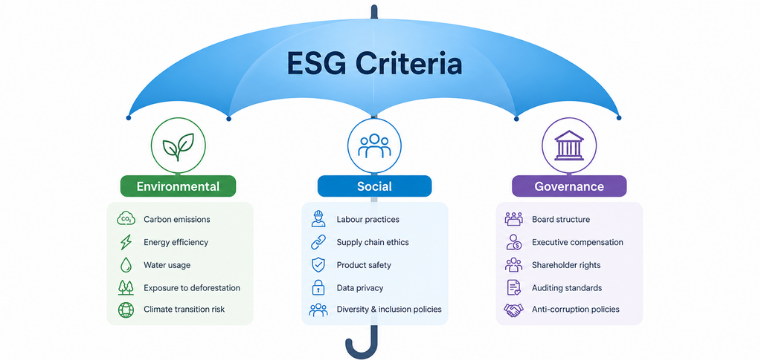
ESG stands for Environmental, Social, and Governance, the three pillars used to assess a company's ethical profile alongside its financials and evaluate its social responsibility.
- Environmental: Factors include carbon emissions, energy efficiency, water usage, exposure to deforestation, and climate transition risk.
- Social: Factors cover labour practices, supply chain ethics, product safety, data privacy, and diversity and inclusion policies.
- Governance: This looks at board structure, executive compensation, shareholder rights, auditing standards, and anti-corruption policies.
Rating agencies such as MSCI and Sustainalytics assign companies standardised ESG scores, giving individual investors and fund managers a comparable way to evaluate ethical performance across industries.
There are several distinct approaches to socially responsible investing, each suited to different goals and risk tolerances:
Negative screening:
This approach excludes certain industries or companies from a portfolio entirely based on ethical grounds. Common exclusions include fossil fuel producers, weapons manufacturers, tobacco companies, and businesses linked to child labour violations.
The method is simple and values-driven, making it a popular starting point for first-time responsible investors who want a clear line between their money and harmful industries.
Positive screening
Positive screening takes the opposite approach; investment managers actively identify and overweight companies that score highly on ESG metrics. Rather than simply avoiding the bad, it seeks out the best, businesses leading their sectors on environmental responsibility, fair labour practices, or transparent governance.
This method rewards companies that do things right and can encourage broader industry improvement over time.
ESG integration
The approach weaves sustainability scores directly into financial analysis without necessarily excluding any asset entirely. It treats ESG data the same way an analyst would treat earnings or debt ratios, as a material input that affects long-term risk and return.
This approach is particularly common among institutional investors and fund managers who want to balance ethical considerations with broad market exposure.
Community Investing
Community investing offers a practical way to get started with socially responsible investing (SRI). This approach focuses on funding businesses and projects that strengthen local economies, create jobs, and support underserved communities.
Instruments for Socially Responsible Investments
Socially responsible investment is not a single product; it is an umbrella category that covers several distinct asset types. Understanding the differences helps you build a portfolio that genuinely reflects your values.
ESG ETFs and Index Funds
These are collective investment vehicles/socially responsible funds that may hold a range of companies selected for their ESG characteristics. They come with the broad market exposure of passive core holdings and embedded ethical screening, and many are offered as low-cost index trackers. This is a great place to start if you're a beginner seeking diversification, without the hassle of selecting individual stocks.
Green Bonds
Green bonds are issued by governments and corporations, but the proceeds must fund specific environmental projects, such as renewable energy infrastructure or sustainable transport, providing fixed-income returns linked to identifiable sustainability outcomes..
Impact Investing funds
Impact Investing is a targeted approach to capital allocation, explicitly earmarked to generate measurable social or environmental benefits. Examples include clean technology startups, affordable housing developers, or social enterprises.
Pension Funds
SRI for pension funds integrates Environmental, Social, and Governance (ESG) criteria into retirement portfolios to yield financial returns alongside positive societal and environmental impacts. Because pension funds hold vast global assets and prioritise long-term payouts, they are major drivers of sustainable and responsible capital allocation.
Sustainable Stocks via CFDs
Investors can use platforms offering CFD trading to gain exposure to companies with strong ESG credentials, even when they lack the capital to buy full shares. This makes stock-level ESG investing available at scale.
Crypto with an ESG Lens
Cryptocurrency is increasingly being discussed in the context of SRI. Bitcoin’s energy consumption remains under scrutiny, but newer blockchain networks often have sustainability and transparency built into their design. While some crypto projects may never align with SRI principles, others have sustainability and transparency as core goals.
Does Socially Responsible Investing Actually Perform?

One of the most compelling aspects of Socially Responsible Investment is that it pays off. Sustainable and responsible investing (SRI/ESG) funds broadly mirror traditional market benchmarks, with long-term annualised returns (CAGR) typically ranging from 7% to 12% across regions over the past decade.
According to a 2024 Morningstar analysis, most sustainable funds beat their conventional counterparts over the previous decade. Portfolios screened for ESG have also been observed to exhibit greater relative resilience during periods of market turbulence, as companies with solid governance and prudent risk management are likely better positioned to navigate volatility, regulatory changes, and reputational crises.
In the short-term, sector allocation is an important determinant of performance. Large technology and clean energy exposure is great for growth in 2020–2021, but a headwind from rising interest rates in 2022, primarily due to the ESG-heavy concentration. However, some broadly diversified sustainable portfolios have struggled to outperform traditional portfolios on a risk-adjusted basis over certain periods.
Regulation is what is causing the numbers to change. The EU's Sustainable Finance Disclosure Regulation (SFDR), which has been in effect since 2021, requires asset managers to disclose how they incorporate sustainability risks into their processes. Such regulation increases scrutiny on companies with weak ESG practices and higher long-term financial risks.
For many investors with a multi-year horizon, ESG alignment has become less about ethics and more a risk-reduction proxy for quality and resilience.
How to Start Socially Responsible Investing
Getting started with SRI is more accessible than it was even five years ago. You do not need a financial advisor, a large starting balance, or specialist knowledge. Here is a practical step-by-step approach for European investors.
1. Define your values
Before choosing any product, find out which problems are important to you: climate change, labour rights, gender equality or corporate transparency. Don’t let your assets determine your values; let your values decide what to do with your investments.
2. Research ESG ratings
Evaluating specific companies or funds with tools like MSCI ESG Ratings or Morningstar's sustainability scores. These will provide an empirically informed benchmark for how the diverse sectors stack up in terms of ethical performance.
3. Choose a regulated, multi-asset platform
Look for a platform that is licensed and regulated in the EU, gives you access to multiple asset classes, and offers transparent pricing. Managing crypto, stock CFDs, and other assets from one place simplifies your strategy and reduces platform risk. Change is fully licensed under EU regulations (MiFID II and MiCA) by the Dutch Authority for the Financial Markets (AFM) and has gained the trust of hundreds of thousands of investors across Europe since its launch..
4. Diversify across asset types
Create a balanced SRI portfolio through ESG ETFs for exposure to equity markets, individual sustainable stocks via CFDs and crypto assets from projects with smaller environmental footprints. Diversification reduces concentration risk while keeping your portfolio aligned with your principles.
5. Use recurring buys to invest consistently
A strategy often used in long-term investing is dollar-cost averaging (DCA), which involves investing a fixed amount at regular intervals, regardless of market conditions. Market timing stress is removed from the equation by spreading investments over time, smoothing out some volatility in periods of market turbulence.
Investing on repeat in a set-and-forget way, thanks to automatic recurring buys on Change, meaning you can build your investment habits without checking markets every day.
Bottom Line
Socially responsible investing has moved well beyond a niche concept; it is now a credible, data-backed strategy that millions of investors are using to build long-term wealth on their own terms.
Over time, consistent and principled investing compounds not just financially but also in the broader impact your capital has on the world around you. That is what makes socially responsible investments one of the most powerful habits a modern investor can build.
Frequently Asked Questions (FAQs)
What is socially responsible investing (SRI)?
Socially responsible investing (SRI) is an investment strategy that focuses on companies with strong environmental, social, and governance (ESG) practices while avoiding harmful industries.
How does socially responsible investing work?
SRI works by selecting stocks, ETFs, or funds that meet ethical, environmental, or social standards alongside financial performance goals.
Is socially responsible investing profitable?
Socially responsible investing can generate competitive long-term returns, especially as ESG-focused companies continue gaining investor and consumer support.
What is the difference between ESG and socially responsible investing?
ESG measures a company’s environmental, social, and governance performance, while socially responsible investment actively uses those factors to guide investment decisions.
What are the benefits of socially responsible investing?
Socially responsible investing helps investors align their portfolios with personal values while supporting sustainable and ethical business practices.
Can beginners invest in socially responsible investment funds?
Yes, beginners can start socially responsible investing through ESG mutual funds, ETFs, or robo-advisors with low minimum investment requirements. Only you can assess what’s right for you. All investing involves risk, including the potential loss of capital.