Oil is one of the most traded commodities on the planet. However, it's not just a commodity but a crucial component of the global economy, affecting financial markets worldwide. Its deep liquidity and trading opportunities make it one of the best tradeable assets in the financial markets.
Whether you want to diversify beyond stocks and crypto or take advantage of market volatility, oil trading opens up a world of opportunities for traders. But many beginner traders don't know how to trade crude oil.
With CFDs, Futures, ETFs, and oil stocks all on the table, traders find it difficult to know how to trade oil. This guide cuts through the noise and shows you exactly the process step by step.
Key Takeaways
- Oil can be traded through CFDs, oil futures, ETFs, or shares in oil companies. CFDs are the most accessible option for beginners
- Crude oil prices are affected by various factors, including OPEC decisions, supply and demand, and global events.
What Is Oil Trading?
Oil trading involves speculating on the price of crude oil, taking a position on whether the commodity’s price will rise or fall without owning any physical barrels of oil. Traders use financial instruments that track the price of oil on global markets, making it possible to participate in one of the world's most liquid commodities from a smartphone.
The three main benchmarks you'll encounter are West Texas Intermediate (WTI), Brent Crude, and the OPEC basket.
WTI crude oil is produced in the United States, while Brent Crude is the global standard used to price oil from the North Sea and in most international markets. The OPEC basket presents the prices from OPEC members. While all closely watch the price, Brent Crude typically has a broader global influence and is the benchmark most European traders focus on.
Main Crude Oil Benchmarks
1. Brent Crude
Brent Crude is the global crude oil price marker. Because Brent mirrors international market conditions, it reacts largely to global events. Brent prices can be affected by supply disruptions, geopolitical tensions, shipping problems, and changes in global oil consumption.
2. West Texas Intermediate (WTI)
WTI crude oil is a major benchmark, produced mostly in the United States. It is easier to develop by refining it into products like gasoline and diesel, since it contains less sulfur and has a lighter composition. Traders often monitor WTI for U.S. oil market conditions. Its price changes with U.S. oil output, crude inventories, U.S. refiner profitability, and domestic fuel consumption.
3. OPEC Basket
The OPEC Basket represents a calculated average price of crude oil produced by OPEC member nations. It does not represent a single oil type but rather blends several crude grades with differing characteristics. Strong influences include OPEC production decisions, political developments in producing regions, and changes in global energy demand.
Different Ways to Trade Oil
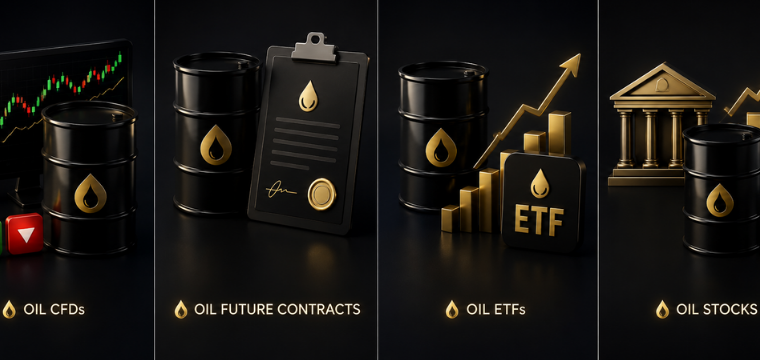
You can access oil trading through several instruments. However, you need to understand the mechanics of each instrument and choose the right approach for your goals, experience, and available capital.
Oil CFDs
A CFD (Contract for Difference) has emerged as one of the most convenient instruments for trading oil without owning the underlying asset.
CFDs let you speculate on crude oil prices without owning the physical commodity. You just have to open a position based on analysis of the direction of the price, and your profit or loss is determined by the difference between your entry and exit prices.
CFDs are the most popular route for retail investors entering oil markets. They work in both directions, you can go long (buy) if you expect prices to rise, or go short (sell) if you expect them to fall. They also support leverage, meaning you can control a larger position with a smaller initial investment.
Modern platforms like Change offer oil CFDs with low minimum entry points, making them accessible even if you're just getting started with commodity trading.
CFDs are complex instruments and come with a high risk of losing money rapidly due to leverage. 60% of retail investor accounts lose money when trading CFDs with this provider. You should consider whether you understand how CFDs work and whether you can afford to take the high risk of losing your money.
Oil Futures Contracts
Futures contracts are also a popular instrument in oil trading. Oil futures contracts are instruments to buy or sell a set quantity of oil at a fixed price on a specific future date. They are primarily used by institutional traders, large commodity firms, and producers who need to hedge against price fluctuations in their physical supply chains.
For retail traders, futures involve higher capital requirements and more complexity than most beginners need. They are traded on dedicated exchanges and come with expiry dates, which adds another layer of management. Oil CFDs offer similar market exposure in a simpler format.
Oil ETFs
An oil ETF (Exchange-Traded Fund) tracks the price of the crude oil market or a basket of oil-related assets and can be bought and sold like a share. However, ETFs are primarily used for medium- to long-term investing rather than active trading.
Some oil ETFs follow crude prices directly, while others invest in major oil company stocks. They are a more passive approach and suit investors who want broad exposure to oil without actively managing trades.
Oil Stocks
Trading shares in oil companies such as BP, Shell, or ExxonMobil is another indirect way to gain exposure to the oil market. When crude prices rise, oil company revenues and profits typically increase, which tends to push their share prices higher.
Stock CFDs on major oil producers are also available on platforms like Change, allowing you to speculate on these companies without purchasing the shares outright.
What Moves Oil Prices?
Oil prices are also driven by various factors, like every other financial instrument. Any news about factors affecting the price of oil could affect your trade. It's worth understanding what actually drives the price of oil. Several forces interact to push prices up or down, often quickly:
- Supply and Demand: It is the most fundamental driver. When global demand rises, typically during periods of strong economic growth and high industrial output, prices tend to increase. When demand weakens or supply outpaces consumption, prices fall.
- OPEC+ Decisions: The decision from the crude oil giants carries enormous weight. The Organization of the Petroleum Exporting Countries and its allies (collectively known as OPEC+) meet regularly to set production targets. A decision to cut production can send prices sharply higher; an increase in supply tends to push them lower. Staying aware of OPEC meeting schedules is a basic part of oil market awareness.
In June 2026, seven major OPEC+ producers, including Saudi Arabia and Russia, agreed to increase oil production by 188,000 barrels per day for July. The decision marked the fourth consecutive monthly increase in output as the group gradually unwound earlier supply cuts.
Because higher production can increase global crude oil supply, the announcement created downward pressure on oil price movements and signaled that OPEC+ was prioritizing market share while still aiming to keep the market balanced.
- Geopolitical Events: Geopolitical volatility can cause sudden, sharp price moves in the crude oil price. Conflicts in major oil-producing regions, international sanctions, pipeline disruptions, or political instability in key exporting nations all affect supply expectations and trader sentiment.
Several other factors can also influence crude oil prices. One of the most closely watched is the weekly crude oil inventory report released by the U.S. Energy Information Administration (EIA) every Wednesday. Higher-than-expected stockpiles can signal weaker demand and put pressure on crude oil prices, while falling inventories often support higher prices.
Since oil trades in U.S. dollars, a stronger dollar makes crude more expensive for buyers using other currencies, which can reduce demand and weigh on prices.
Manufacturing activity, industrial output, and GDP growth forecasts help traders gauge future energy consumption. Strong economic growth typically increases demand for crude oil, while signs of a slowdown can weaken the outlook for prices.
How to Trade Oil CFDs Step by Step
For most retail investors, oil CFDs offer the most direct and accessible path into oil markets. Here's a step-by-step process:
Step 1: Choose a regulated trading platform
Select a platform that is licensed and regulated in your region. Before choosing a trading platform, check its history and whether it offers the tools you need for your trading. New-age trusted platform like Change, which is authorized and regulated by the Dutch Authority for the Financial Markets (AFM), providing EU-compliant access to oil CFDs and a range of other markets.
Step 2: Open and verify your account.
Registration is simple and fast thanks to advanced technologies like KYC. You'll need to provide identification documents as part of the platform's KYC (Know Your Customer) compliance process, standard practice on all regulated platforms.
Step 3: Fund your account
Many platforms allow a low minimum investment for trading, which will help you get started as a beginner. You can start trading with as little as €10, with instant deposits available via card.
Step 4: Analyze the market before taking a trade
Review the current price of oil, recent news, and any upcoming events that could move markets, such as an OPEC meeting on the crude oil market, EIA inventory release, or major geopolitical development. Decide whether you expect the price to rise (go long) or fall (go short). Set your position size, apply a stop-loss to cap potential losses, and confirm the trade.
Step 5: Monitor and close your position
Risk management is one of the most crucial aspects of trading any financial instrument, and it is true for oil trading as well. Track your open trade and close it when your profit target is reached or when the market moves beyond your risk tolerance.
How to Analyse the Oil Market
Successful oil traders typically use a combination of two analytical approaches: fundamental analysis and technical analysis:
Fundamental Analysis
Fundamental traders track the economic and geopolitical factors that drive crude oil supply and demand. Key sources include EIA weekly inventory reports, OPEC production decisions, and global demand forecasts from bodies such as the International Energy Agency. According to the EIA, the United States produced a record average of 13.2 million barrels per day in 2024. Data points like these give traders a real-time picture of supply conditions. Past price movements are not a reliable indicator of future performance.
CFDs are complex instruments and come with a high risk of losing money rapidly due to leverage. 60% of retail investor accounts lose money when trading CFDs with this provider. You should consider whether you understand how CFDs work and whether you can afford to take the high risk of losing your money.
Technical Analysis
Technical analysis involves studying price charts and applying tools to spot patterns and identify potential trade setups in oil trading. Common tools include:
- Support and resistance levels, price points where oil has historically reversed direction
- Moving averages are used to identify the overall trend direction
- The Relative Strength Index (RSI) shows whether oil is currently overbought or oversold
Advantages and disadvantages of Oil trading
Bottom Line
Oil markets offer some of the most dynamic trading opportunities available, but having the right understanding, oil trading strategy, and platform matters.
Change gives you access to oil CFDs alongside cryptocurrencies, stock CFDs, commodities, and more, all from one regulated EU platform. You can open an account in minutes and start trading with just €10, with no hidden fees and instant deposits.
Frequently Asked Questions
What is the best way for beginners to trade oil?
Beginners typically start with oil CFDs through a regulated broker and a clear risk management plan.
What factors affect oil prices the most?
Oil prices are mainly influenced by OPEC decisions, supply-demand dynamics, geopolitical events, and U.S. crude inventory data.
Can you trade oil without buying physical barrels?
Yes. Instead of buying physical barrels, most traders prefer gaining exposure to the oil market through CFDs. Change allows you to do exactly that, offering seamless oil CFD trading directly in the app.
What is the best time to trade oil?
Oil trading is usually most active during U.S. market hours and around major economic or inventory data releases.
Is oil trading suitable for short-term traders?
Yes, oil's high liquidity and price volatility make it popular among day traders and swing traders.